Advertisements
Advertisements
प्रश्न
If two sides of a triangle are 5 cm and 1.5 cm, the length of its third side cannot be ______.
विकल्प
3.7 cm
4.1 cm
3.8 cm
3.4 cm
Advertisements
उत्तर
If two sides of a triangle are 5 cm and 1.5 cm, the length of its third side cannot be 3.4 cm.
Explanation:
Sum of the lengths of two sides of a triangle > length of the third side.
Here, 1.5 cm + 3.4 cm
= 4.9 cm < 5 cm
∴ Third side ≠ 3.4 cm
APPEARS IN
संबंधित प्रश्न
Two angles of a triangle are equal and the third angle is greater than each of those angles
by 30°. Determine all the angles of the triangle.
The bisectors of base angles of a triangle cannot enclose a right angle in any case.
Is the following statement true and false :
If one angle of a triangle is obtuse, then it cannot be a right angled triangle.
In a triangle, an exterior angle at a vertex is 95° and its one of the interior opposite angle is 55°, then the measure of the other interior angle is
In a triangle ABC, ∠A = 45° and ∠B = 75°, find ∠C.
Calculate the angles of a triangle if they are in the ratio 4: 5: 6.
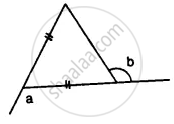
In the given figure, express a in terms of b.
Find x, if the angles of a triangle is:
2x°, 4x°, 6x°
Find, giving a reason, the unknown marked angles, in a triangle drawn below:

Classify the following triangle according to sides:

Match the following:
| Column A | Column B |
| (i) No sides are equal | Isosceles triangle |
| (ii) One right angle | Scalene triangle |
| (iii) One obtuse angle | Right angled triangle |
| (iv) Two sides of equal length | Equilateral triangle |
| (v) All sides are equal | Obtuse angled triangle |
Q is a point on the side SR of a ∆PSR such that PQ = PR. Prove that PS > PQ.
Bisectors of the angles B and C of an isosceles triangle with AB = AC intersect each other at O. BO is produced to a point M. Prove that ∠MOC = ∠ABC.
Prove that in a triangle, other than an equilateral triangle, angle opposite the longest side is greater than `2/3` of a right angle.
Can we have two acute angles whose sum is an acute angle? Why or why not?
Can we have two acute angles whose sum is a right angle? Why or why not?
Can we have two acute angles whose sum is an obtuse angle? Why or why not?
Identify three triangles in the figure.
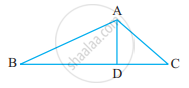
How is a vertex of triangle △ABC most accurately defined?
