Advertisements
Advertisements
Question
If two sides of a triangle are 5 cm and 1.5 cm, the length of its third side cannot be ______.
Options
3.7 cm
4.1 cm
3.8 cm
3.4 cm
Advertisements
Solution
If two sides of a triangle are 5 cm and 1.5 cm, the length of its third side cannot be 3.4 cm.
Explanation:
Sum of the lengths of two sides of a triangle > length of the third side.
Here, 1.5 cm + 3.4 cm
= 4.9 cm < 5 cm
∴ Third side ≠ 3.4 cm
APPEARS IN
RELATED QUESTIONS
In a ΔABC, if ∠A = 55°, ∠B = 40°, find ∠C.
ABC is a triangle in which ∠A — 72°, the internal bisectors of angles B and C meet in O.
Find the magnitude of ∠BOC.
Can a triangle have All angles equal to 60°? Justify your answer in case.
Is the following statement true and false :
An exterior angle of a triangle is greater than the opposite interior angles.
Fill in the blank to make the following statement true:
An exterior angle of a triangle is equal to the two ....... opposite angles.
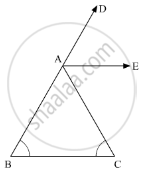
In the given figure, AE bisects ∠CAD and ∠B= ∠C. Prove that AE || BC.
An exterior angle of a triangle is equal to 100° and two interior opposite angles are equal. Each of these angles is equal to
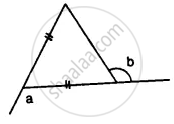
In the given figure, express a in terms of b.
Can a triangle together have the following angles?
55°, 55° and 80°
Can a triangle together have the following angles?
33°, 74° and 73°
One angle of a right-angled triangle is 70°. Find the other acute angle.
Find, giving a reason, the unknown marked angles, in a triangle drawn below:

The length of the three segments is given for constructing a triangle. Say whether a triangle with these sides can be drawn. Give the reason for your answer.
8.4 cm, 16.4 cm, 4.9 cm
The exterior angle of a triangle is equal to the sum of two
The correct statement out of the following is 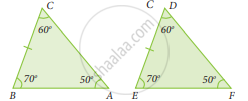
In the given figure, AB is parallel to CD. Then the value of b is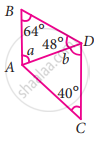
In the following figure, PQ ⊥ RQ, PQ = 5 cm and QR = 5 cm. Then ∆PQR is ______.

Can we have two acute angles whose sum is a straight angle? Why or why not?
Draw a rough sketch of a triangle ABC. Mark a point P in its interior and a point Q in its exterior. Is point A in its exterior or in its interior?
What is the sum of the measures of the interior angles of any triangle, △ABC?
