Advertisements
Advertisements
Question
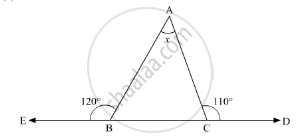
Compute the value of x in the following figure:
Advertisements
Solution
In the given problem, we need to find the value of x
In the given ΔABC, ∠ACD = 110° and ∠EBA = 120°

Here, BCD is a straight line. So, using the property, “the angles forming a linear pair are supplementary” we get,
∠ACB + ∠ACD = 180°
∠ACB + 110° = 180°
∠ACB = 180° - 110°
∠ACB = 70°
Similarly, EBC is a straight line. So, we get
∠EBA + ∠ABC = 180°
120° + ∠ABC = 180°
∠ABC = 180° - 120°
∠ABC = 60° V
Further, using the angle sum property of a triangle,
In ΔABC
∠ACB + ∠BAC + ∠ABC = 180°
70° + 60° ∠BAC = 180°
130° + ∠BAC = 180°
∠BAC = 180° - 130°
∠BAC = 50°
Therefore, x = 50°
APPEARS IN
RELATED QUESTIONS
Determine the measure of each of the equal angles of a right-angled isosceles triangle.
OR
ABC is a right-angled triangle in which ∠A = 90° and AB = AC. Find ∠B and ∠C.
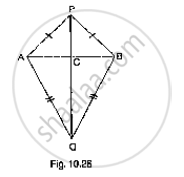
AB is a line segment. P and Q are points on opposite sides of AB such that each of them is equidistant from the points A and B (See Fig. 10.26). Show that the line PQ is perpendicular bisector of AB.
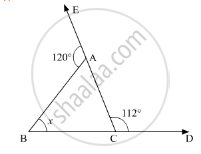
Compute the value of x in the following figure:
Is the following statement true and false :
A triangle can have two obtuse angles.
Is the following statement true and false :
An exterior angle of a triangle is less than either of its interior opposite angles.
If the sides of a triangle are produced in order, then the sum of the three exterior angles so formed is
In ΔPQR, If ∠R > ∠Q then ______.
One of the base angles of an isosceles triangle is 52°. Find its angle of the vertex.
Can you draw a triangle with 25°, 65° and 80° as angles?
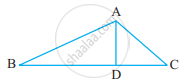
Which two triangles have ∠B in common?