Advertisements
Advertisements
प्रश्न
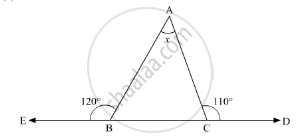
Compute the value of x in the following figure:
Advertisements
उत्तर
In the given problem, we need to find the value of x
In the given ΔABC, ∠ACD = 110° and ∠EBA = 120°

Here, BCD is a straight line. So, using the property, “the angles forming a linear pair are supplementary” we get,
∠ACB + ∠ACD = 180°
∠ACB + 110° = 180°
∠ACB = 180° - 110°
∠ACB = 70°
Similarly, EBC is a straight line. So, we get
∠EBA + ∠ABC = 180°
120° + ∠ABC = 180°
∠ABC = 180° - 120°
∠ABC = 60° V
Further, using the angle sum property of a triangle,
In ΔABC
∠ACB + ∠BAC + ∠ABC = 180°
70° + 60° ∠BAC = 180°
130° + ∠BAC = 180°
∠BAC = 180° - 130°
∠BAC = 50°
Therefore, x = 50°
APPEARS IN
संबंधित प्रश्न
Fill in the blank to make the following statement true:
A triangle cannot have more than ...... right angles.
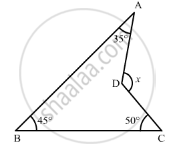
In the given figure, compute the value of x.
The sum of two angles of a triangle is equal to its third angle. Determine the measure of the third angle.
State, if the triangle is possible with the following angles :
40°, 130°, and 20°
In ∆ABC, ∠A = ∠B = 62° ; find ∠C.
Classify the following triangle according to sides:

Match the following:
| Column A | Column B |
| (i) No sides are equal | Isosceles triangle |
| (ii) One right angle | Scalene triangle |
| (iii) One obtuse angle | Right angled triangle |
| (iv) Two sides of equal length | Equilateral triangle |
| (v) All sides are equal | Obtuse angled triangle |
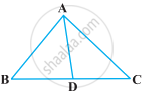
In the following figure, AD is the bisector of ∠BAC. Prove that AB > BD.
The number of angles in the following figure is ______.

Jincy used these shapes to make drawings of fish.

Now you also use some shapes to draw the different sea animals shown below.

Sea urchin

Lobster

Eel

Red snapper

Octopus

Clam

Parrotfish

Prawn

Cuttlefish

Jellyfish

Squid

Silver pomfret

Crab
