Advertisements
Advertisements
प्रश्न
The angles of a triangle are (x − 40)°, (x − 20)° and `(1/2x-10)^@.` find the value of x
Advertisements
उत्तर
Given that
The angles of triangle are
`(x-40^@),(x-20)^@ and (x/2-10)^@`
We know that
Sum of all angles of traingle is `180^@`
∴ `x-40^@+x-20^@+x/2-10^@=180^@`
`2x+x/2-70^@=180^@`
`(5x)/2=180+70^@`
`5x=250^@(2)`
`x=50^@(2)`
`x=100^@`
∴ `x=100^@`
APPEARS IN
संबंधित प्रश्न
If the angles of a triangle are in the ratio 1: 2 : 3, determine three angles.
Fill in the blank to make the following statement true:
A triangles cannot have more than ......obtuse angles.
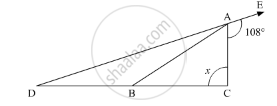
In the given figure, AB divides ∠DAC in the ratio 1 : 3 and AB = DB. Determine the value of x.
The sum of two angles of a triangle is equal to its third angle. Determine the measure of the third angle.
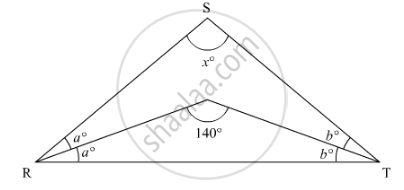
In ΔRST (See figure), what is the value of x?
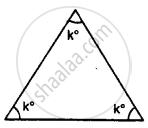
Find the unknown marked angles in the given figure:
In the given figure, show that: ∠a = ∠b + ∠c
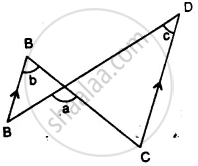
(i) If ∠b = 60° and ∠c = 50° ; find ∠a.
(ii) If ∠a = 100° and ∠b = 55° : find ∠c.
(iii) If ∠a = 108° and ∠c = 48° ; find ∠b.
Calculate the unknown marked angles of the following figure :
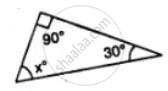
In the following, find the marked unknown angle:
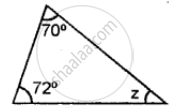
Can a triangle together have the following angles?
85°, 95° and 22°
