Advertisements
Advertisements
प्रश्न
D is any point on side AC of a ∆ABC with AB = AC. Show that CD < BD.
Advertisements
उत्तर
Given in triangle ABC, D is any point on side AC such that AB = AC.
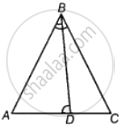
To proof that CD < BD or BD > CD
To proof: AC = AB ...[Given]
∠ABC = ∠ACB ...(i) [Angle opposite to equal sides are equal]
In triangle ABC and triangle DBC,
∠ABC > ∠DBC ...[∠DBC is a internal angle of ∠B]
∠ACB > ∠DBC ...[From equation (i)]
BD > CD ...[Side opposite to greater angle is longer]
CD < BD
APPEARS IN
संबंधित प्रश्न
The angles of a triangle are (x − 40)°, (x − 20)° and `(1/2x-10)^@.` find the value of x
Can a triangle have All angles less than 60° Justify your answer in case.
Determine the measure of each of the equal angles of a right-angled isosceles triangle.
OR
ABC is a right-angled triangle in which ∠A = 90° and AB = AC. Find ∠B and ∠C.
Is the following statement true and false :
All the angles of a triangle can be equal to 60°.
Is the following statement true and false :
An exterior angle of a triangle is greater than the opposite interior angles.
If the sides of a triangle are produced in order, then the sum of the three exterior angles so formed is
In ΔPQR, If ∠R > ∠Q then ______.
In the following, find the marked unknown angle:
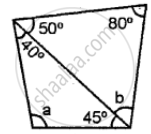
Find, giving a reason, the unknown marked angles, in a triangle drawn below:

Match the following:
| Column A | Column B |
| (i) No sides are equal | Isosceles triangle |
| (ii) One right angle | Scalene triangle |
| (iii) One obtuse angle | Right angled triangle |
| (iv) Two sides of equal length | Equilateral triangle |
| (v) All sides are equal | Obtuse angled triangle |
