Advertisements
Advertisements
प्रश्न
D is any point on side AC of a ∆ABC with AB = AC. Show that CD < BD.
Advertisements
उत्तर
Given in triangle ABC, D is any point on side AC such that AB = AC.
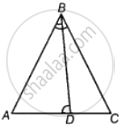
To proof that CD < BD or BD > CD
To proof: AC = AB ...[Given]
∠ABC = ∠ACB ...(i) [Angle opposite to equal sides are equal]
In triangle ABC and triangle DBC,
∠ABC > ∠DBC ...[∠DBC is a internal angle of ∠B]
∠ACB > ∠DBC ...[From equation (i)]
BD > CD ...[Side opposite to greater angle is longer]
CD < BD
APPEARS IN
संबंधित प्रश्न
ABC is a triangle in which ∠A — 72°, the internal bisectors of angles B and C meet in O.
Find the magnitude of ∠BOC.
Can a triangle have two acute angles?Justify your answer in case.
Is the following statement true and false :
Sum of the three angles of a triangle is 180 .
Is the following statement true and false :
If one angle of a triangle is obtuse, then it cannot be a right angled triangle.
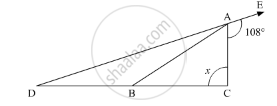
In the given figure, AB divides ∠DAC in the ratio 1 : 3 and AB = DB. Determine the value of x.
Find x, if the angles of a triangle is:
x°, x°, x°
The length of the three segments is given for constructing a triangle. Say whether a triangle with these sides can be drawn. Give the reason for your answer.
15 cm, 20 cm, 25 cm
The exterior angle of a triangle is equal to the sum of two
In a ∆ABC, AB = AC. The value of x is ________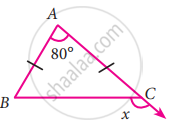
In the following figure, l || m and M is the mid-point of a line segment AB. Show that M is also the mid-point of any line segment CD, having its end points on l and m, respectively.

