Advertisements
Advertisements
प्रश्न
S is any point on side QR of a ∆PQR. Show that: PQ + QR + RP > 2PS.
Advertisements
उत्तर
Given: In ∆PQR, S is any point on side QR.

To show: PQ + QR + RP > 2PS
Proof: In ∆PQS,
PQ + QS > PS ...(i) [Sum of two sides of a triangle is greater than the third side]
Similarly, in ∆PRS,
SR + RP > PS ...(ii) [Sum of two sides of a triangle is greater than the third side]
On adding equations (i) and (ii), we get
PQ + QS + SR + RP > 2PS
⇒ PQ + (QS + SR) + RP > 2PS
⇒ PQ + QR + RP > 2PS ...[∵ QR = QS + SR]
APPEARS IN
संबंधित प्रश्न
Determine the measure of each of the equal angles of a right-angled isosceles triangle.
OR
ABC is a right-angled triangle in which ∠A = 90° and AB = AC. Find ∠B and ∠C.
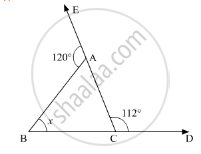
Compute the value of x in the following figure:
Is the following statement true and false :
A triangle can have two right angles.
If two acute angles of a right triangle are equal, then each acute is equal to
An exterior angle of a triangle is 108° and its interior opposite angles are in the ratio 4 : 5. The angles of the triangle are
The bisects of exterior angle at B and C of ΔABC meet at O. If ∠A = x°, then ∠BOC =
Can a triangle together have the following angles?
55°, 55° and 80°
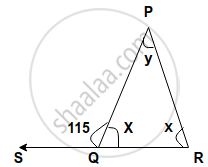
Find, giving a reason, the unknown marked angles, in a triangle drawn below:
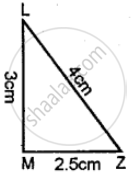
Classify the following triangle according to sides:
The length of the sides of the triangle is given. Say what types of triangles they are 3.4 cm, 3.4 cm, 5 cm.
