Advertisements
Advertisements
Question
S is any point on side QR of a ∆PQR. Show that: PQ + QR + RP > 2PS.
Advertisements
Solution
Given: In ∆PQR, S is any point on side QR.

To show: PQ + QR + RP > 2PS
Proof: In ∆PQS,
PQ + QS > PS ...(i) [Sum of two sides of a triangle is greater than the third side]
Similarly, in ∆PRS,
SR + RP > PS ...(ii) [Sum of two sides of a triangle is greater than the third side]
On adding equations (i) and (ii), we get
PQ + QS + SR + RP > 2PS
⇒ PQ + (QS + SR) + RP > 2PS
⇒ PQ + QR + RP > 2PS ...[∵ QR = QS + SR]
APPEARS IN
RELATED QUESTIONS
If one angle of a triangle is equal to the sum of the other two, show that the triangle is a
right triangle.
ABC is a triangle in which ∠A — 72°, the internal bisectors of angles B and C meet in O.
Find the magnitude of ∠BOC.
Compute the value of x in the following figure:
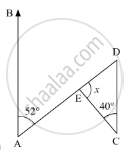
Is the following statement true and false :
An exterior angle of a triangle is equal to the sum of the two interior opposite angles.
State exterior angle theorem.
The bisects of exterior angle at B and C of ΔABC meet at O. If ∠A = x°, then ∠BOC =
Find x, if the angles of a triangle is:
x°, 2x°, 2x°
The exterior angle of a triangle is equal to the sum of two
In the following figure, AD is the bisector of ∠BAC. Prove that AB > BD.

In the following figure, PQ ⊥ RQ, PQ = 5 cm and QR = 5 cm. Then ∆PQR is ______.

