Advertisements
Advertisements
Question
D is any point on side AC of a ∆ABC with AB = AC. Show that CD < BD.
Advertisements
Solution
Given in triangle ABC, D is any point on side AC such that AB = AC.
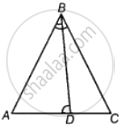
To proof that CD < BD or BD > CD
To proof: AC = AB ...[Given]
∠ABC = ∠ACB ...(i) [Angle opposite to equal sides are equal]
In triangle ABC and triangle DBC,
∠ABC > ∠DBC ...[∠DBC is a internal angle of ∠B]
∠ACB > ∠DBC ...[From equation (i)]
BD > CD ...[Side opposite to greater angle is longer]
CD < BD
APPEARS IN
RELATED QUESTIONS
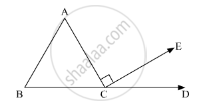
In the given figure, AC ⊥ CE and ∠A : ∠B : ∠C = 3 : 2 : 1, find the value of ∠ECD.
In a Δ ABC, the internal bisectors of ∠B and ∠C meet at P and the external bisectors of ∠B and ∠C meet at Q, Prove that ∠BPC + ∠BQC = 180°.
In a triangle PQR, ∠P = 60° and ∠Q = ∠R, find ∠R.
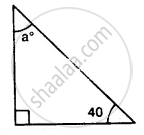
Calculate the unknown marked angles of the following figure :
In the given figure, show that: ∠a = ∠b + ∠c
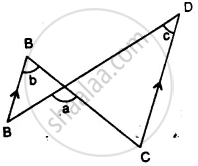
(i) If ∠b = 60° and ∠c = 50° ; find ∠a.
(ii) If ∠a = 100° and ∠b = 55° : find ∠c.
(iii) If ∠a = 108° and ∠c = 48° ; find ∠b.
In ∆ABC, C = 56° C = 56° ∠B = ∠C and ∠A = 100° ; find ∠B.
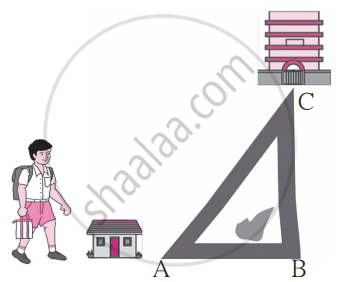
As shown in the figure, Avinash is standing near his house. He can choose from two roads to go to school. Which way is shorter? Explain why.
The number of angles in the following figure is ______.

The number of triangles in the following figure is ______. Their names are ______.

What is common in the following figure?
 |
 |
| (i) | (ii) |
Is figure (i) that of triangle? if not, why?
