Advertisements
Advertisements
प्रश्न
S is any point on side QR of a ∆PQR. Show that: PQ + QR + RP > 2PS.
Advertisements
उत्तर
Given: In ∆PQR, S is any point on side QR.

To show: PQ + QR + RP > 2PS
Proof: In ∆PQS,
PQ + QS > PS ...(i) [Sum of two sides of a triangle is greater than the third side]
Similarly, in ∆PRS,
SR + RP > PS ...(ii) [Sum of two sides of a triangle is greater than the third side]
On adding equations (i) and (ii), we get
PQ + QS + SR + RP > 2PS
⇒ PQ + (QS + SR) + RP > 2PS
⇒ PQ + QR + RP > 2PS ...[∵ QR = QS + SR]
APPEARS IN
संबंधित प्रश्न
Can a triangle have All angles more than 60°? Justify your answer in case.
Determine the measure of each of the equal angles of a right-angled isosceles triangle.
OR
ABC is a right-angled triangle in which ∠A = 90° and AB = AC. Find ∠B and ∠C.
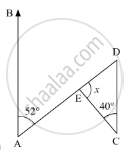
Compute the value of x in the following figure:
Is the following statement true and false :
A triangle can have two obtuse angles.
The sum of two angles of a triangle is equal to its third angle. Determine the measure of the third angle.
In ΔABC, if bisectors of ∠ABC and ∠ACB intersect at O at angle of 120°, then find the measure of ∠A.
If one angle of a triangle is equal to the sum of the other two angles, then the triangle is
In ΔPQR, If ∠R > ∠Q then ______.
In a triangle PQR, ∠P = 60° and ∠Q = ∠R, find ∠R.
Calculate the unknown marked angles of the following figure :