Advertisements
Advertisements
Question
In a Δ ABC, the internal bisectors of ∠B and ∠C meet at P and the external bisectors of ∠B and ∠C meet at Q, Prove that ∠BPC + ∠BQC = 180°.
Advertisements
Solution
In the given problem, BP and CP are the internal bisectors of ∠B and ∠C respectively. Also, BQ and CQ are the external bisectors of ∠B and ∠C respectively. Here, we need to prove:
∠BPC +∠BQC = 180°

We know that if the bisectors of angles ∠ABC and ∠ACB of ΔABC meet at a point O then` ∠BOC = 90° + 1/2 ∠A`.
Thus, in ΔABC
`∠BPC = 90° + 1/2 ∠A.` ……(1)
Also, using the theorem, “if the sides AB and AC of a ΔABC are produced, and the external bisectors of ∠B and ∠Cmeet at O, then `∠BOC = 90° + 1/2 ∠A.` .
Thus, ΔABC
\[\angle BQC = 90^\circ - \frac{1}{2}\angle A . . . . . . \left( 2 \right)\]
Adding (1) and (2), we get
`∠BOC +∠BQC = 90° + 1/2 ∠A + 90° -1/2 ∠A`
∠BQC + ∠BQC = 180°
Thus, `∠BQC + ∠BQC = 180°
Hence proved.
APPEARS IN
RELATED QUESTIONS
The angles of a triangle are arranged in ascending order of magnitude. If the difference
between two consecutive angles is 10°, find the three angles.
Is the following statement true and false :
A triangle can have at most one obtuse angles.
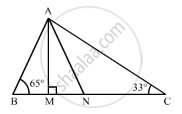
In the given figure, AM ⊥ BC and AN is the bisector of ∠A. If ∠B = 65° and ∠C = 33°, find ∠MAN.
Classify the following triangle according to sides:

The length of the sides of the triangle is given. Say what types of triangles they are 3 cm, 4 cm, 5 cm.
The length of the sides of the triangle is given. Say what types of triangles they are 4.3 cm, 4.3 cm, 4.3 cm.
The length of the three segments is given for constructing a triangle. Say whether a triangle with these sides can be drawn. Give the reason for your answer.
9 cm, 6 cm, 16 cm
The angles of the triangle are 3x – 40, x + 20 and 2x – 10 then the value of x is
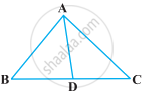
In the following figure, AD is the bisector of ∠BAC. Prove that AB > BD.
In the following figure, AB = BC and AD = BD = DC. The number of isosceles triangles in the figure is ______.

