Advertisements
Advertisements
Question
In ΔABC, ∠B = ∠C and ray AX bisects the exterior angle ∠DAC. If ∠DAX = 70°, then ∠ACB =
Options
35°
90°
70°
55°
Advertisements
Solution
In the given ΔABC, ∠B = ∠C . D is the ray extended from point A. AX bisects∠DAC and ∠DAX = 70°
Here, we need to find ∠ACB
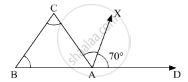
As ray AX bisects ∠DAC
∠CAX = ∠DAX = 70°
Thus,
∠DAC = ∠DAX + ∠XAC
= 70° + 70°
= 140°
Now, according to the property, “exterior angle of a triangle is equal to the sum of two opposite interior angles”, we get,
∠DAC = ∠B + ∠C
140° = 2∠C
`∠C = (140°)/2`
= 70°
Thus, ∠ACB = 70°
APPEARS IN
RELATED QUESTIONS
If the angles of a triangle are in the ratio 1: 2 : 3, determine three angles.
The angles of a triangle are (x − 40)°, (x − 20)° and `(1/2x-10)^@.` find the value of x
If one angle of a triangle is equal to the sum of the other two, show that the triangle is a
right triangle.
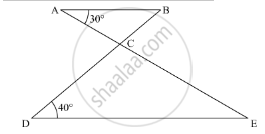
In the given figure, AB || DE. Find ∠ACD.
Is the following statement true and false :
If one angle of a triangle is obtuse, then it cannot be a right angled triangle.
Is the following statement true and false :
An exterior angle of a triangle is less than either of its interior opposite angles.
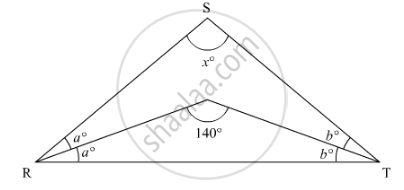
In ΔRST (See figure), what is the value of x?
The length of the sides of the triangle is given. Say what types of triangles they are 3.4 cm, 3.4 cm, 5 cm.
The angles of a triangle are in the ratio 2 : 3 : 4. Then the angles are
What is the sum of the measures of the interior angles of any triangle, △ABC?
