Advertisements
Advertisements
Question
If one angle of a triangle is equal to the sum of the other two angles, then the triangle is
Options
an isosceles triangle
an obtuse triangle
an equilateral triangle
a right triangle
Advertisements
Solution
In the given problem, one angle of a triangle is equal to the sum of the other two angles.
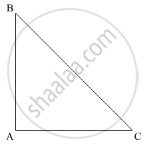
Thus,
∠A = ∠B + ∠C ..........(1)
Now, according to the angle sum property of the triangle
In ΔABC
∠A + ∠B + ∠C = 180°
∠B + ∠C +∠B + ∠C = 180°
2(∠B + ∠C ) = 180°
`∠B + ∠C = (180°)/2 `
∠B + ∠C = 90° .........(2)
Further, using (2) in (1),
∠A = ∠B + ∠C
∠A = 90°
Thus, ∠A = 90°
APPEARS IN
RELATED QUESTIONS
If the angles of a triangle are in the ratio 1: 2 : 3, determine three angles.
Determine the measure of each of the equal angles of a right-angled isosceles triangle.
OR
ABC is a right-angled triangle in which ∠A = 90° and AB = AC. Find ∠B and ∠C.
Fill in the blank to make the following statement true:
A triangles cannot have more than ......obtuse angles.
Mark the correct alternative in each of the following:
If all the three angles of a triangle are equal, then each one of them is equal to
Side BC of a triangle ABC has been produced to a point D such that ∠ACD = 120°. If ∠B = \[\frac{1}{2}\]∠A is equal to
State, if the triangle is possible with the following angles :
40°, 130°, and 20°
Classify the following triangle according to sides:

The length of the sides of the triangle is given. Say what types of triangles they are 3.7 cm, 3.4 cm, 4 cm.
S is any point on side QR of a ∆PQR. Show that: PQ + QR + RP > 2PS.
Bisectors of the angles B and C of an isosceles triangle with AB = AC intersect each other at O. BO is produced to a point M. Prove that ∠MOC = ∠ABC.
