Advertisements
Advertisements
प्रश्न
In ΔABC, ∠B = ∠C and ray AX bisects the exterior angle ∠DAC. If ∠DAX = 70°, then ∠ACB =
पर्याय
35°
90°
70°
55°
Advertisements
उत्तर
In the given ΔABC, ∠B = ∠C . D is the ray extended from point A. AX bisects∠DAC and ∠DAX = 70°
Here, we need to find ∠ACB
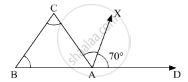
As ray AX bisects ∠DAC
∠CAX = ∠DAX = 70°
Thus,
∠DAC = ∠DAX + ∠XAC
= 70° + 70°
= 140°
Now, according to the property, “exterior angle of a triangle is equal to the sum of two opposite interior angles”, we get,
∠DAC = ∠B + ∠C
140° = 2∠C
`∠C = (140°)/2`
= 70°
Thus, ∠ACB = 70°
APPEARS IN
संबंधित प्रश्न
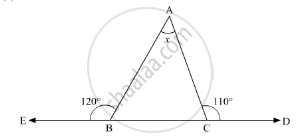
Compute the value of x in the following figure:
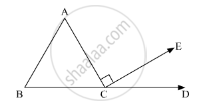
In the given figure, AC ⊥ CE and ∠A : ∠B : ∠C = 3 : 2 : 1, find the value of ∠ECD.
Is the following statement true and false :
All the angles of a triangle can be equal to 60°.
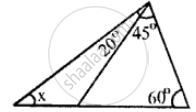
In the following, find the marked unknown angle:
Classify the following triangle according to sides:

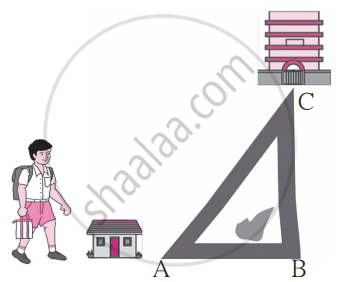
As shown in the figure, Avinash is standing near his house. He can choose from two roads to go to school. Which way is shorter? Explain why.
The length of the three segments is given for constructing a triangle. Say whether a triangle with these sides can be drawn. Give the reason for your answer.
17 cm, 7 cm, 8 cm
Bisectors of the angles B and C of an isosceles triangle with AB = AC intersect each other at O. BO is produced to a point M. Prove that ∠MOC = ∠ABC.
The number of angles in the following figure is ______.

How is a vertex of triangle △ABC most accurately defined?
