Advertisements
Advertisements
प्रश्न
If the side BC of ΔABC is produced on both sides, then write the difference between the sum of the exterior angles so formed and ∠A.
Advertisements
उत्तर
In the given problem, we need to find the difference between the sum of the exterior angles and∠A.
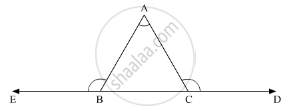
Now, according to the exterior angle theorem
ext. ∠C = ∠A + ∠B .........(1)
Also,
ext. ∠B = ∠A + ∠C .........(2)
Further, adding (1) and (2)
ext. ∠C + ext. ∠B = ∠A + ∠B + ∠A + ∠B
=2∠A+ ∠B + ∠C .........(3)
Also, according to the angle sum property of the triangle, we get,
∠A + ∠B + ∠C = 180° .........(4)
Now, we need to find the difference between the sum of the exterior angles and ∠A
Thus,
( ext. ∠C + ext. ∠B) - ∠A = (2∠A + ∠B + ∠C ) - ∠A
= ∠A = ∠B + ∠C
= 180°(Using 4)
Therefore, (ext. ∠C ext.∠B) -∠A = 180°
APPEARS IN
संबंधित प्रश्न
Is the following statement true and false :
An exterior angle of a triangle is equal to the sum of the two interior opposite angles.
Fill in the blank to make the following statement true:
A triangles cannot have more than ......obtuse angles.
In ΔABC, if bisectors of ∠ABC and ∠ACB intersect at O at angle of 120°, then find the measure of ∠A.
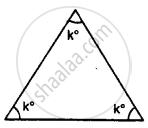
If the angles of a triangle are equal, find its angles.
Find the unknown marked angles in the given figure:
One of the base angles of an isosceles triangle is 52°. Find its angle of the vertex.
Classify the following triangle according to sides:
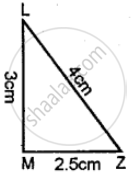
Classify the following triangle according to sides:
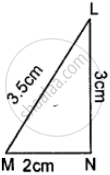
The length of the three segments is given for constructing a triangle. Say whether a triangle with these sides can be drawn. Give the reason for your answer.
9 cm, 6 cm, 16 cm
In ΔABC, name the 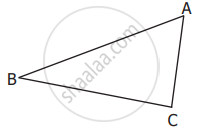
a) Three sides: _________, __________, __________
b) Three Angles: _________, __________, __________
c) Three Vertices: _________, __________, __________
