Advertisements
Advertisements
प्रश्न
Side BC of a triangle ABC has been produced to a point D such that ∠ACD = 120°. If ∠B = \[\frac{1}{2}\]∠A is equal to
पर्याय
80°
75°
60°
90°
Advertisements
उत्तर
In the given problem, side BC of ΔABC has been produced to a point D. Such that ∠ACD = 120° and `∠B = 1/2 ∠A` . Here, we need to find ∠A
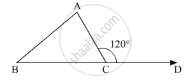
Given `∠B = 1/2 ∠A`
We get, ∠A = 2∠B .........(1)
Now, using the property, “exterior angle of a triangle is equal to the sum of two opposite interior angles”, we get,
In ΔABC
∠ACD = ∠A + ∠B
120° = 2∠B + ∠B
120° = 3∠B
`∠B = (120°)/3`
∠B = 40°
Also, ∠A = 2∠B(Using 1)
∠ A = 2 (40°)
= 80°
Thus, ∠A = 80°
APPEARS IN
संबंधित प्रश्न
ABC is a triangle in which ∠A — 72°, the internal bisectors of angles B and C meet in O.
Find the magnitude of ∠BOC.
Can a triangle have All angles less than 60° Justify your answer in case.
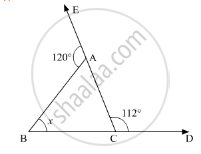
Compute the value of x in the following figure:
Is the following statement true and false :
All the angles of a triangle can be equal to 60°.
Is the following statement true and false :
A triangle can have two obtuse angles.
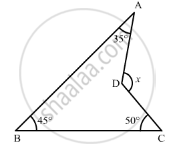
In the given figure, compute the value of x.
Mark the correct alternative in each of the following:
If all the three angles of a triangle are equal, then each one of them is equal to
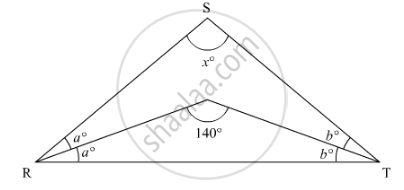
In ΔRST (See figure), what is the value of x?
State, if the triangle is possible with the following angles :
40°, 130°, and 20°
What is the sum of the measures of the interior angles of any triangle, △ABC?
