Advertisements
Advertisements
प्रश्न
The correct statement out of the following is 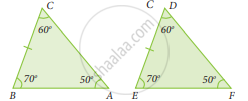
पर्याय
ΔABC ≅ ΔDEF
ΔABC ≅ ΔEDF
ΔABC ≅ ΔFDE
ΔABC ≅ ΔFED
Advertisements
उत्तर
The correct statement out of the following is ΔABC ≅ ΔFED
APPEARS IN
संबंधित प्रश्न
If each angle of a triangle is less than the sum of the other two, show that the triangle is acute angled.
Determine the measure of each of the equal angles of a right-angled isosceles triangle.
OR
ABC is a right-angled triangle in which ∠A = 90° and AB = AC. Find ∠B and ∠C.
Define a triangle.
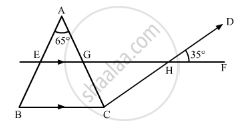
In the given figure, if AB || CD, EF || BC, ∠BAC = 65° and ∠DHF = 35°, find ∠AGH.
One of the base angles of an isosceles triangle is 52°. Find its angle of the vertex.
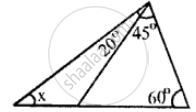
In the following, find the marked unknown angle:
Classify the following triangle according to sides:

Q is a point on the side SR of a ∆PSR such that PQ = PR. Prove that PS > PQ.
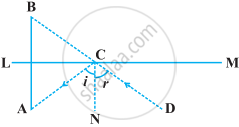
The image of an object placed at a point A before a plane mirror LM is seen at the point B by an observer at D as shown in the following figure. Prove that the image is as far behind the mirror as the object is in front of the mirror.
[Hint: CN is normal to the mirror. Also, angle of incidence = angle of reflection].
Can we have two acute angles whose sum is a straight angle? Why or why not?
