Advertisements
Advertisements
प्रश्न
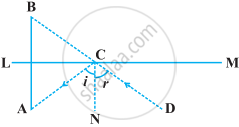
The image of an object placed at a point A before a plane mirror LM is seen at the point B by an observer at D as shown in the following figure. Prove that the image is as far behind the mirror as the object is in front of the mirror.
[Hint: CN is normal to the mirror. Also, angle of incidence = angle of reflection].
Advertisements
उत्तर १
Given: An object OA placed at a point A, LM be a plane mirror, D be an observer and OB is the image.
To prove: The image is as far behind the mirror as the object is in front of the mirror i.e., OB = OA.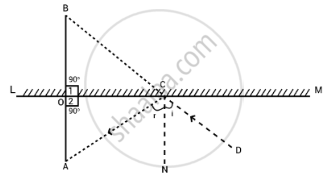
Proof: CN ⊥ LM and AB ⊥ LM
⇒ AB || CN
∠A = ∠i [Alternate interior angles] ...(i)
∠B = ∠r [Corresponding angles] ...(ii)
Also, ∠i = ∠r [∵ incident angle = reflected angle] ...(iii)
From equations (i), (ii) and (iii),
∠A = ∠B
In ΔCOB and ΔCOA,
∠B = ∠A ...[Proved above]
∠1 = ∠2 ...[Each 90°]
And CO = CO ...[Common side]
∴ ΔCOB ≅ ΔCOA ...[By AAS congruence rule]
⇒ OB = OA ...[By CPCT]
Hence proved.
उत्तर २
In ΔOBC and ΔOAC,
∠1 = ∠2 ...[Each 90°]
Also, ∠i = ∠r [∵ incident angle = reflected angle] ...(i)
On multiplying both sides of equation (i) by –1 and then adding 90° both sides, we get
90° – ∠i = 90° – ∠r
⇒ ∠ACO = ∠BCO
And OC = OC ...[Common side]
∴ ΔOBC ≅ ΔOAC ...[By ASA congruence rule]
⇒ OB = OA ...[By CPCT]
Hence, the image is as far behind the mirror as the object is in front of the mirror.
APPEARS IN
संबंधित प्रश्न
Is the following statement true and false :
A triangle can have at most one obtuse angles.
In Δ ABC, BD⊥ AC and CE ⊥ AB. If BD and CE intersect at O, prove that ∠BOC = 180° − A.
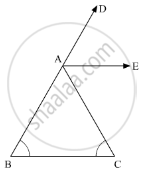
In the given figure, AE bisects ∠CAD and ∠B= ∠C. Prove that AE || BC.
In a triangle ABC, ∠A = 45° and ∠B = 75°, find ∠C.
Can a triangle together have the following angles?
55°, 55° and 80°
Classify the following triangle according to sides:

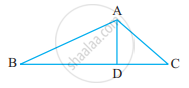
In the following figure, ∠BAC = 90° and AD ⊥ BC. The number of right triangles in the figure is ______.

In the following figure, PQ ⊥ RQ, PQ = 5 cm and QR = 5 cm. Then ∆PQR is ______.

Identify three triangles in the figure.
The sides of a triangle must always be connected so that:
