Advertisements
Advertisements
Question
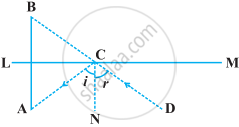
The image of an object placed at a point A before a plane mirror LM is seen at the point B by an observer at D as shown in the following figure. Prove that the image is as far behind the mirror as the object is in front of the mirror.
[Hint: CN is normal to the mirror. Also, angle of incidence = angle of reflection].
Advertisements
Solution 1
Given: An object OA placed at a point A, LM be a plane mirror, D be an observer and OB is the image.
To prove: The image is as far behind the mirror as the object is in front of the mirror i.e., OB = OA.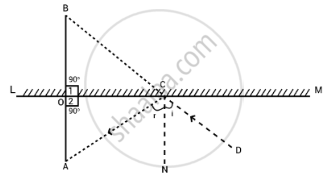
Proof: CN ⊥ LM and AB ⊥ LM
⇒ AB || CN
∠A = ∠i [Alternate interior angles] ...(i)
∠B = ∠r [Corresponding angles] ...(ii)
Also, ∠i = ∠r [∵ incident angle = reflected angle] ...(iii)
From equations (i), (ii) and (iii),
∠A = ∠B
In ΔCOB and ΔCOA,
∠B = ∠A ...[Proved above]
∠1 = ∠2 ...[Each 90°]
And CO = CO ...[Common side]
∴ ΔCOB ≅ ΔCOA ...[By AAS congruence rule]
⇒ OB = OA ...[By CPCT]
Hence proved.
Solution 2
In ΔOBC and ΔOAC,
∠1 = ∠2 ...[Each 90°]
Also, ∠i = ∠r [∵ incident angle = reflected angle] ...(i)
On multiplying both sides of equation (i) by –1 and then adding 90° both sides, we get
90° – ∠i = 90° – ∠r
⇒ ∠ACO = ∠BCO
And OC = OC ...[Common side]
∴ ΔOBC ≅ ΔOAC ...[By ASA congruence rule]
⇒ OB = OA ...[By CPCT]
Hence, the image is as far behind the mirror as the object is in front of the mirror.
APPEARS IN
RELATED QUESTIONS
The angles of a triangle are arranged in ascending order of magnitude. If the difference
between two consecutive angles is 10°, find the three angles.
In a Δ ABC, the internal bisectors of ∠B and ∠C meet at P and the external bisectors of ∠B and ∠C meet at Q, Prove that ∠BPC + ∠BQC = 180°.
In a Δ ABC, AD bisects ∠A and ∠C > ∠B. Prove that ∠ADB > ∠ADC.
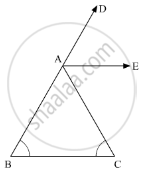
In the given figure, AE bisects ∠CAD and ∠B= ∠C. Prove that AE || BC.
If the side BC of ΔABC is produced on both sides, then write the difference between the sum of the exterior angles so formed and ∠A.
The angle of a vertex of an isosceles triangle is 100°. Find its base angles.
In ∆ABC, C = 56° C = 56° ∠B = ∠C and ∠A = 100° ; find ∠B.
Match the following:
| Column A | Column B |
| (i) No sides are equal | Isosceles triangle |
| (ii) One right angle | Scalene triangle |
| (iii) One obtuse angle | Right angled triangle |
| (iv) Two sides of equal length | Equilateral triangle |
| (v) All sides are equal | Obtuse angled triangle |
P is a point on the bisector of ∠ABC. If the line through P, parallel to BA meet BC at Q, prove that BPQ is an isosceles triangle.
Prove that in a triangle, other than an equilateral triangle, angle opposite the longest side is greater than `2/3` of a right angle.
