Advertisements
Advertisements
प्रश्न
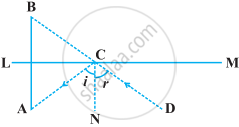
The image of an object placed at a point A before a plane mirror LM is seen at the point B by an observer at D as shown in the following figure. Prove that the image is as far behind the mirror as the object is in front of the mirror.
[Hint: CN is normal to the mirror. Also, angle of incidence = angle of reflection].
Advertisements
उत्तर १
Given: An object OA placed at a point A, LM be a plane mirror, D be an observer and OB is the image.
To prove: The image is as far behind the mirror as the object is in front of the mirror i.e., OB = OA.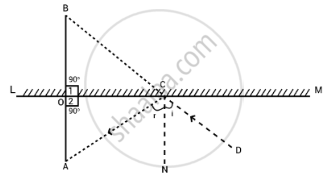
Proof: CN ⊥ LM and AB ⊥ LM
⇒ AB || CN
∠A = ∠i [Alternate interior angles] ...(i)
∠B = ∠r [Corresponding angles] ...(ii)
Also, ∠i = ∠r [∵ incident angle = reflected angle] ...(iii)
From equations (i), (ii) and (iii),
∠A = ∠B
In ΔCOB and ΔCOA,
∠B = ∠A ...[Proved above]
∠1 = ∠2 ...[Each 90°]
And CO = CO ...[Common side]
∴ ΔCOB ≅ ΔCOA ...[By AAS congruence rule]
⇒ OB = OA ...[By CPCT]
Hence proved.
उत्तर २
In ΔOBC and ΔOAC,
∠1 = ∠2 ...[Each 90°]
Also, ∠i = ∠r [∵ incident angle = reflected angle] ...(i)
On multiplying both sides of equation (i) by –1 and then adding 90° both sides, we get
90° – ∠i = 90° – ∠r
⇒ ∠ACO = ∠BCO
And OC = OC ...[Common side]
∴ ΔOBC ≅ ΔOAC ...[By ASA congruence rule]
⇒ OB = OA ...[By CPCT]
Hence, the image is as far behind the mirror as the object is in front of the mirror.
APPEARS IN
संबंधित प्रश्न
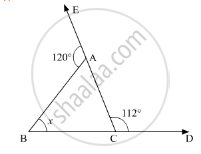
Compute the value of x in the following figure:
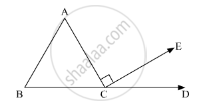
In the given figure, AC ⊥ CE and ∠A : ∠B : ∠C = 3 : 2 : 1, find the value of ∠ECD.
Is the following statement true and false :
If one angle of a triangle is obtuse, then it cannot be a right angled triangle.
Fill in the blank to make the following statement true:
An exterior angle of a triangle is always ......... than either of the interior opposite angles.
In Δ ABC, if u∠B = 60°, ∠C = 80° and the bisectors of angles ∠ABC and ∠ACB meet at a point O, then find the measure of ∠BOC.
In a triangle PQR, ∠P = 60° and ∠Q = ∠R, find ∠R.
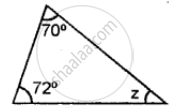
In the following, find the marked unknown angle:
The length of the three segments is given for constructing a triangle. Say whether a triangle with these sides can be drawn. Give the reason for your answer.
7 cm, 24 cm, 25 cm
D is any point on side AC of a ∆ABC with AB = AC. Show that CD < BD.
AB and CD are the smallest and largest sides of a quadrilateral ABCD. Out of ∠B and ∠D decide which is greater.
