Advertisements
Advertisements
प्रश्न
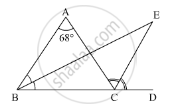
In the given figure, side BC of ΔABC is produced to point D such that bisectors of ∠ABC and ∠ACD meet at a point E. If ∠BAC = 68°, find ∠BEC.
Advertisements
उत्तर
In the given figure, bisectors of ∠ABC and ∠ACD meet at E and ∠BAC = 68°
We need to find ∠BEC

Here, using the property: an exterior angle of the triangle is equal to the sum of the opposite interior angles.
In ΔABC with ∠ACD as its exterior angle
exterior ∠ACD = ∠A +∠ABC ........(1)
Similarly, in ΔBE with ∠ECD as its exterior angle
exterior ∠ECD = ∠EBC + ∠BEC
`1/2 ∠"ACD" = 1/2 ∠"ABC" + ∠"BEC"` (CE and BE are the bisectors of ∠ACD and) ∠ABC
`∠"BEC" = 1/2 ∠"ACD" - 1/2 ∠"ABC"` ........(2)
Now, multiplying both sides of (1) by 1/2
We get,
`1/2 ∠"ACD" = 1/2 ∠"A" +1/2 ∠"ABC"`
`1/2 ∠"A" = 1/2 ∠"ACD" - 1/2∠"ABC"` ........(3)
From (2) and (3) we get,
`∠"BEC" = 1/2 ∠"A"`
`∠"BEC" = 1/2(68°)`
∠BEC = 34°
Thus, ∠BEC = 34°
APPEARS IN
संबंधित प्रश्न
The bisectors of base angles of a triangle cannot enclose a right angle in any case.
Fill in the blank to make the following statement true:
An exterior angle of a triangle is always ......... than either of the interior opposite angles.
Fill in the blank to make the following statement true:
A triangle cannot have more than ...... right angles.
In a Δ ABC, the internal bisectors of ∠B and ∠C meet at P and the external bisectors of ∠B and ∠C meet at Q, Prove that ∠BPC + ∠BQC = 180°.
State, if the triangle is possible with the following angles :
125°, 40°, and 15°
Find x, if the angles of a triangle is:
2x°, 4x°, 6x°
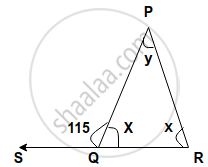
Find, giving a reason, the unknown marked angles, in a triangle drawn below:
Classify the following triangle according to sides:

The angles of the triangle are 3x – 40, x + 20 and 2x – 10 then the value of x is
What is the sum of the measures of the interior angles of any triangle, △ABC?
