Advertisements
Advertisements
Question
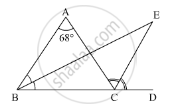
In the given figure, side BC of ΔABC is produced to point D such that bisectors of ∠ABC and ∠ACD meet at a point E. If ∠BAC = 68°, find ∠BEC.
Advertisements
Solution
In the given figure, bisectors of ∠ABC and ∠ACD meet at E and ∠BAC = 68°
We need to find ∠BEC

Here, using the property: an exterior angle of the triangle is equal to the sum of the opposite interior angles.
In ΔABC with ∠ACD as its exterior angle
exterior ∠ACD = ∠A +∠ABC ........(1)
Similarly, in ΔBE with ∠ECD as its exterior angle
exterior ∠ECD = ∠EBC + ∠BEC
`1/2 ∠"ACD" = 1/2 ∠"ABC" + ∠"BEC"` (CE and BE are the bisectors of ∠ACD and) ∠ABC
`∠"BEC" = 1/2 ∠"ACD" - 1/2 ∠"ABC"` ........(2)
Now, multiplying both sides of (1) by 1/2
We get,
`1/2 ∠"ACD" = 1/2 ∠"A" +1/2 ∠"ABC"`
`1/2 ∠"A" = 1/2 ∠"ACD" - 1/2∠"ABC"` ........(3)
From (2) and (3) we get,
`∠"BEC" = 1/2 ∠"A"`
`∠"BEC" = 1/2(68°)`
∠BEC = 34°
Thus, ∠BEC = 34°
APPEARS IN
RELATED QUESTIONS
If each angle of a triangle is less than the sum of the other two, show that the triangle is acute angled.
Fill in the blank to make the following statement true:
A triangles cannot have more than ......obtuse angles.
In a Δ ABC, AD bisects ∠A and ∠C > ∠B. Prove that ∠ADB > ∠ADC.
In a triangle, an exterior angle at a vertex is 95° and its one of the interior opposite angle is 55°, then the measure of the other interior angle is
Can a triangle together have the following angles?
33°, 74° and 73°
Find all the three angles of the ΔABC
D is any point on side AC of a ∆ABC with AB = AC. Show that CD < BD.
In the following figure, PQ ⊥ RQ, PQ = 5 cm and QR = 5 cm. Then ∆PQR is ______.

The number of triangles in the following figure is ______. Their names are ______.

Identify three triangles in the figure.