Advertisements
Advertisements
Question
State exterior angle theorem.
Advertisements
Solution
Exterior angle theorem states that, if a side of a triangle is produced, the exterior angle so formed is equal to the sum of the two interior opposite angles.
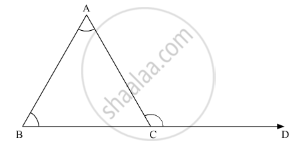
Thus, in ΔABC
∠ACD = ∠A +∠B
APPEARS IN
RELATED QUESTIONS
In a ΔABC, ∠ABC = ∠ACB and the bisectors of ∠ABC and ∠ACB intersect at O such that ∠BOC = 120°. Show that ∠A = ∠B = ∠C = 60°.
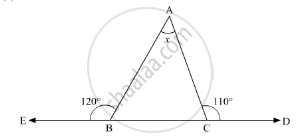
Compute the value of x in the following figure:
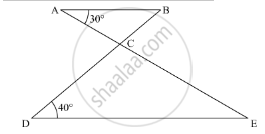
In the given figure, AB || DE. Find ∠ACD.
State, if the triangle is possible with the following angles :
40°, 130°, and 20°
State, if the triangle is possible with the following angles :
125°, 40°, and 15°
If an angle of a triangle is equal to the sum of the other two angles, find the type of the triangle
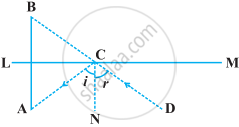
The image of an object placed at a point A before a plane mirror LM is seen at the point B by an observer at D as shown in the following figure. Prove that the image is as far behind the mirror as the object is in front of the mirror.
[Hint: CN is normal to the mirror. Also, angle of incidence = angle of reflection].
P is a point on the bisector of ∠ABC. If the line through P, parallel to BA meet BC at Q, prove that BPQ is an isosceles triangle.
The number of angles in the following figure is ______.

In the following figure, ∠BAC = 90° and AD ⊥ BC. The number of right triangles in the figure is ______.

