Advertisements
Advertisements
प्रश्न
State exterior angle theorem.
Advertisements
उत्तर
Exterior angle theorem states that, if a side of a triangle is produced, the exterior angle so formed is equal to the sum of the two interior opposite angles.
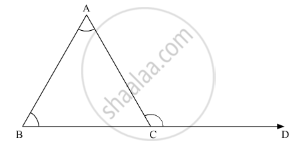
Thus, in ΔABC
∠ACD = ∠A +∠B
APPEARS IN
संबंधित प्रश्न
Can a triangle have two obtuse angles? Justify your answer in case.
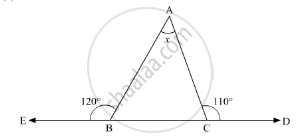
Compute the value of x in the following figure:
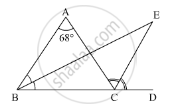
In the given figure, side BC of ΔABC is produced to point D such that bisectors of ∠ABC and ∠ACD meet at a point E. If ∠BAC = 68°, find ∠BEC.
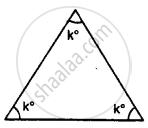
An exterior angle of a triangle is equal to 100° and two interior opposite angles are equal. Each of these angles is equal to
Find the unknown marked angles in the given figure:
One angle of a triangle is 61° and the other two angles are in the ratio `1 1/2: 1 1/3`. Find these angles.
Can you draw a triangle with 25°, 65° and 80° as angles?
In the given figure, AB is parallel to CD. Then the value of b is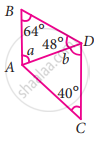
Q is a point on the side SR of a ∆PSR such that PQ = PR. Prove that PS > PQ.
Can we have two acute angles whose sum is an acute angle? Why or why not?
