Advertisements
Advertisements
प्रश्न
State exterior angle theorem.
Advertisements
उत्तर
Exterior angle theorem states that, if a side of a triangle is produced, the exterior angle so formed is equal to the sum of the two interior opposite angles.
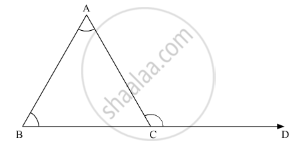
Thus, in ΔABC
∠ACD = ∠A +∠B
APPEARS IN
संबंधित प्रश्न
Can a triangle have two obtuse angles? Justify your answer in case.
Is the following statement true and false :
An exterior angle of a triangle is less than either of its interior opposite angles.
In the given figure, AE bisects ∠CAD and ∠B= ∠C. Prove that AE || BC.
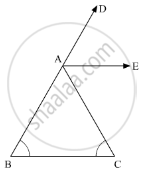
In ΔABC, ∠B = ∠C and ray AX bisects the exterior angle ∠DAC. If ∠DAX = 70°, then ∠ACB =
Can a triangle together have the following angles?
85°, 95° and 22°
Find, giving a reason, the unknown marked angles, in a triangle drawn below:
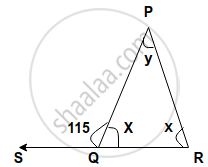
Classify the following triangle according to angle:

The length of the sides of the triangle is given. Say what types of triangles they are 3.7 cm, 3.4 cm, 4 cm.
The length of the three segments is given for constructing a triangle. Say whether a triangle with these sides can be drawn. Give the reason for your answer.
8.4 cm, 16.4 cm, 4.9 cm
The exterior angle of a triangle is equal to the sum of two
