Advertisements
Advertisements
प्रश्न
The angles of a triangle are (x − 40)°, (x − 20)° and `(1/2x-10)^@.` find the value of x
Advertisements
उत्तर
Given that
The angles of triangle are
`(x-40^@),(x-20)^@ and (x/2-10)^@`
We know that
Sum of all angles of traingle is `180^@`
∴ `x-40^@+x-20^@+x/2-10^@=180^@`
`2x+x/2-70^@=180^@`
`(5x)/2=180+70^@`
`5x=250^@(2)`
`x=50^@(2)`
`x=100^@`
∴ `x=100^@`
APPEARS IN
संबंधित प्रश्न
Can a triangle have All angles less than 60° Justify your answer in case.
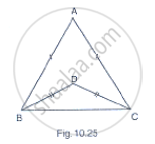
In Fig. 10.25, AB = AC and DB = DC, find the ratio ∠ABD : ∠ACD.
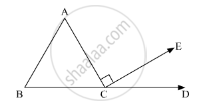
In the given figure, AC ⊥ CE and ∠A : ∠B : ∠C = 3 : 2 : 1, find the value of ∠ECD.
Is the following statement true and false :
A triangle can have two right angles.
An exterior angle of a triangle is equal to 100° and two interior opposite angles are equal. Each of these angles is equal to
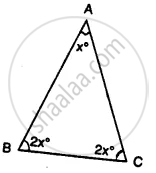
Find the value of the angle in the given figure:
The length of the sides of the triangle is given. Say what types of triangles they are 3.4 cm, 3.4 cm, 5 cm.
Find all the three angles of the ΔABC
Can you draw a triangle with 25°, 65° and 80° as angles?
The number of angles in the following figure is ______.

