Advertisements
Advertisements
प्रश्न
The angles of a triangle are arranged in ascending order of magnitude. If the difference
between two consecutive angles is 10°, find the three angles.
Advertisements
उत्तर
Given that,
The difference between two consecutive angles is `10^@`
Let x,x+10,x+20 be the consecutive angles differ by `10^@`
W.K.T sum of all angles of traingle is `180^@`
`x+x+10+x+20=180^@`
`3x+30=180^@`
⇒ `3x=180-30^@ ⇒ 3x=150^@`
⇒`x=50^@`
∴ `x=50^@`
∴ The required angles are
x,x+10 and x+20
x=50
x+10=50+10=60
x+20=50+10+10=70
The difference between two consecutive angles is `10^@` then three angles are ` 50^@,60^@ and 70^@`
APPEARS IN
संबंधित प्रश्न
Is the following statement true and false :
A triangle can have at most one obtuse angles.
State exterior angle theorem.
If two acute angles of a right triangle are equal, then each acute is equal to
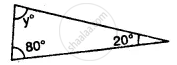
Calculate the unknown marked angles of the following figure :
Can a triangle together have the following angles?
55°, 55° and 80°
Can a triangle together have the following angles?
33°, 74° and 73°
Find x, if the angles of a triangle is:
x°, x°, x°
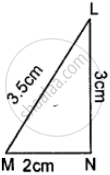
Classify the following triangle according to sides:
O is a point in the interior of a square ABCD such that OAB is an equilateral triangle. Show that ∆OCD is an isosceles triangle.
The sides of a triangle must always be connected so that:
