Advertisements
Advertisements
प्रश्न
The angles of a triangle are arranged in ascending order of magnitude. If the difference
between two consecutive angles is 10°, find the three angles.
Advertisements
उत्तर
Given that,
The difference between two consecutive angles is `10^@`
Let x,x+10,x+20 be the consecutive angles differ by `10^@`
W.K.T sum of all angles of traingle is `180^@`
`x+x+10+x+20=180^@`
`3x+30=180^@`
⇒ `3x=180-30^@ ⇒ 3x=150^@`
⇒`x=50^@`
∴ `x=50^@`
∴ The required angles are
x,x+10 and x+20
x=50
x+10=50+10=60
x+20=50+10+10=70
The difference between two consecutive angles is `10^@` then three angles are ` 50^@,60^@ and 70^@`
APPEARS IN
संबंधित प्रश्न
ABC is a triangle in which ∠A — 72°, the internal bisectors of angles B and C meet in O.
Find the magnitude of ∠BOC.
In a ΔABC, ∠ABC = ∠ACB and the bisectors of ∠ABC and ∠ACB intersect at O such that ∠BOC = 120°. Show that ∠A = ∠B = ∠C = 60°.
State, if the triangle is possible with the following angles :
125°, 40°, and 15°
In a triangle ABC, ∠A = 45° and ∠B = 75°, find ∠C.
Calculate the unknown marked angles of the following figure :
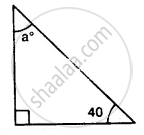
One of the base angles of an isosceles triangle is 52°. Find its angle of the vertex.
In ∆ABC, C = 56° C = 56° ∠B = ∠C and ∠A = 100° ; find ∠B.
Classify the following triangle according to sides:

The length of the three segments is given for constructing a triangle. Say whether a triangle with these sides can be drawn. Give the reason for your answer.
15 cm, 20 cm, 25 cm
If an angle of a triangle is equal to the sum of the other two angles, find the type of the triangle
