Advertisements
Advertisements
प्रश्न
In ∆ABC, C = 56° C = 56° ∠B = ∠C and ∠A = 100° ; find ∠B.
Advertisements
उत्तर
∠A + ∠B + ∠C = 180°
⇒ 100° + ∠B + ∠B = 180°
⇒ 2∠B = 180° 100°
∠B = `(80°)/2`
∠B = 40°
∠C = ∠B = 40°
APPEARS IN
संबंधित प्रश्न
If the angles of a triangle are in the ratio 1: 2 : 3, determine three angles.
Is the following statement true and false :
All the angles of a triangle can be equal to 60°.
Define a triangle.
If two sides of a triangle are 5 cm and 1.5 cm, the length of its third side cannot be ______.
Find the unknown marked angles in the given figure:
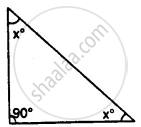
Calculate the unknown marked angles of the following figure :
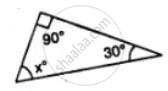
In the following, find the marked unknown angle:
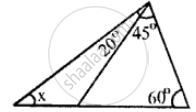
The length of the three segments is given for constructing a triangle. Say whether a triangle with these sides can be drawn. Give the reason for your answer.
9 cm, 6 cm, 16 cm
In the given figure, AB is parallel to CD. Then the value of b is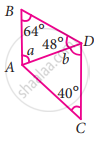
In the following figure, AB = BC and AD = BD = DC. The number of isosceles triangles in the figure is ______.

