Advertisements
Advertisements
प्रश्न
In ∆ABC, ∠A = ∠B = 62° ; find ∠C.
Advertisements
उत्तर
∠A + ∠B + ∠C= 180°
⇒ 62° + 62° + ∠C = 180°
⇒ 124° + ∠C = 180°
⇒ ∠C = 180° – 124°
⇒∠C = 56°
APPEARS IN
संबंधित प्रश्न
The angles of a triangle are arranged in ascending order of magnitude. If the difference
between two consecutive angles is 10°, find the three angles.
If the bisectors of the base angles of a triangle enclose an angle of 135°, prove that the triangle is a right triangle.
Can a triangle have two right angles? Justify your answer in case.
The exterior angles, obtained on producing the base of a triangle both way are 104° and 136°. Find all the angles of the triangle.
In the given figure, AC ⊥ CE and ∠A : ∠B : ∠C = 3 : 2 : 1, find the value of ∠ECD.
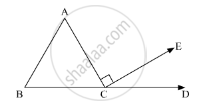
Is the following statement true and false :
All the angles of a triangle can be less than 60°
In the given figure, show that: ∠a = ∠b + ∠c
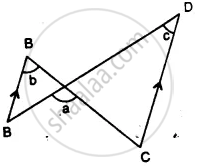
(i) If ∠b = 60° and ∠c = 50° ; find ∠a.
(ii) If ∠a = 100° and ∠b = 55° : find ∠c.
(iii) If ∠a = 108° and ∠c = 48° ; find ∠b.
Can 30°, 60° and 90° be the angles of a triangle?
The number of triangles in the following figure is ______. Their names are ______.

Can we have two acute angles whose sum is a right angle? Why or why not?
