Advertisements
Advertisements
प्रश्न
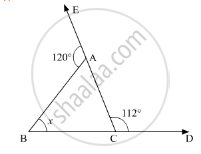
Compute the value of x in the following figure:
Advertisements
उत्तर
In the given problem, we need to find the value of x
In the given ΔABC, ∠ACD = 112° and ∠BAE = 120°
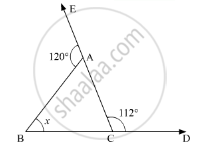
Now, BCD is a straight line. So, using the property, “the angles forming a linear pair are supplementary”, we get,
∠ABC + ∠ACD = 180°
∠ABC + 112 = 180°
∠ACB = 180° - 112°
∠ACB = 68°
Similarly, EAC is a straight line. So, we get,
∠BAE + ∠BAC = 180°
120° + ∠BAC = 180°
∠BAC = 180° - 120°
∠BAC = 60°
Further, using the angle sum property of a triangle,
In ΔABC
∠ACB + ∠BAC + ∠ABC = 180°
68° + 60° + ∠ABC = 180°
128° + ∠ABC = 180° -128°
∠ABC = 52°
Therefore, x = 52°
APPEARS IN
संबंधित प्रश्न
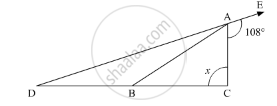
In the given figure, AB divides ∠DAC in the ratio 1 : 3 and AB = DB. Determine the value of x.
In a triangle, an exterior angle at a vertex is 95° and its one of the interior opposite angle is 55°, then the measure of the other interior angle is
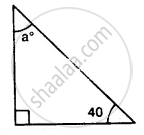
Calculate the unknown marked angles of the following figure :
In the given figure, show that: ∠a = ∠b + ∠c
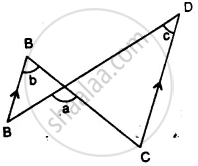
(i) If ∠b = 60° and ∠c = 50° ; find ∠a.
(ii) If ∠a = 100° and ∠b = 55° : find ∠c.
(iii) If ∠a = 108° and ∠c = 48° ; find ∠b.
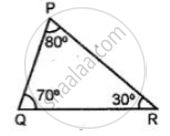
Classify the following triangle according to angle:
The angles of the triangle are 3x – 40, x + 20 and 2x – 10 then the value of x is
Can you draw a triangle with 25°, 65° and 80° as angles?
In the following figure, AB = BC and AD = BD = DC. The number of isosceles triangles in the figure is ______.

What is common in the following figure?
 |
 |
| (i) | (ii) |
Is figure (i) that of triangle? if not, why?
Can we have two acute angles whose sum is a reflex angle? Why or why not?
