Advertisements
Advertisements
प्रश्न
P is a point on the bisector of ∠ABC. If the line through P, parallel to BA meet BC at Q, prove that BPQ is an isosceles triangle.
Advertisements
उत्तर
Given in the question, P is a point on the bisector of ∠ABC. If the line through P, parallel to BA meet BC at Q.
To prove: BPQ is an isosceles triangle.
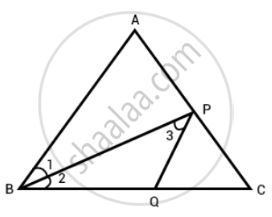
Proof: ∠1 = ∠2 ...(i) [BP is the bisector of ∠ABC]
PQ is parallel to BA and BP cuts them.
So, ∠1 = ∠3 ...[Alternate interior angles as PQ || AB]
∠2 = ∠3 ...[Proved above]
PQ = BQ ...[Sides opposite to equal angle are equal]
Hence, BPQ is an isosceles triangle.
APPEARS IN
संबंधित प्रश्न
The angles of a triangle are arranged in ascending order of magnitude. If the difference
between two consecutive angles is 10°, find the three angles.
If one angle of a triangle is equal to the sum of the other two, show that the triangle is a
right triangle.
In a Δ ABC, the internal bisectors of ∠B and ∠C meet at P and the external bisectors of ∠B and ∠C meet at Q, Prove that ∠BPC + ∠BQC = 180°.
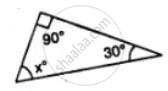
Calculate the unknown marked angles of the following figure :
Find x, if the angles of a triangle is:
x°, 2x°, 2x°
The angles of the triangle are 3x – 40, x + 20 and 2x – 10 then the value of x is
One of the angles of a triangle is 65°. If the difference of the other two angles is 45°, then the two angles are
In the following figure, PQ ⊥ RQ, PQ = 5 cm and QR = 5 cm. Then ∆PQR is ______.

Can we have two acute angles whose sum is an acute angle? Why or why not?
How many sides does a triangle have?
