Advertisements
Advertisements
Question
P is a point on the bisector of ∠ABC. If the line through P, parallel to BA meet BC at Q, prove that BPQ is an isosceles triangle.
Advertisements
Solution
Given in the question, P is a point on the bisector of ∠ABC. If the line through P, parallel to BA meet BC at Q.
To prove: BPQ is an isosceles triangle.
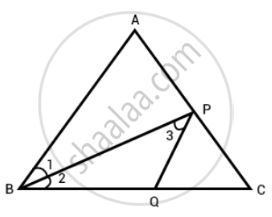
Proof: ∠1 = ∠2 ...(i) [BP is the bisector of ∠ABC]
PQ is parallel to BA and BP cuts them.
So, ∠1 = ∠3 ...[Alternate interior angles as PQ || AB]
∠2 = ∠3 ...[Proved above]
PQ = BQ ...[Sides opposite to equal angle are equal]
Hence, BPQ is an isosceles triangle.
APPEARS IN
RELATED QUESTIONS
Can a triangle have All angles less than 60° Justify your answer in case.
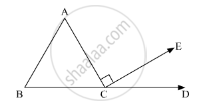
In the given figure, AC ⊥ CE and ∠A : ∠B : ∠C = 3 : 2 : 1, find the value of ∠ECD.
If the side BC of ΔABC is produced on both sides, then write the difference between the sum of the exterior angles so formed and ∠A.
State, if the triangle is possible with the following angles :
60°, 60°, and 50°
In the given figure, show that: ∠a = ∠b + ∠c
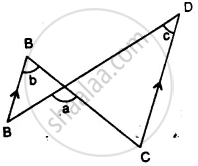
(i) If ∠b = 60° and ∠c = 50° ; find ∠a.
(ii) If ∠a = 100° and ∠b = 55° : find ∠c.
(iii) If ∠a = 108° and ∠c = 48° ; find ∠b.
One angle of a triangle is 60°. The other two angles are in the ratio of 5: 7. Find the two angles.
Find, giving a reason, the unknown marked angles, in a triangle drawn below:

Classify the following triangle according to sides:

In the following figure, AB = BC and AD = BD = DC. The number of isosceles triangles in the figure is ______.

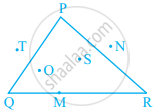
In the following figure, points lying in the interior of the triangle PQR are ______, that in the exterior are ______ and that on the triangle itself are ______.