Advertisements
Advertisements
Question
ABCD is a quadrilateral in which AB = BC and AD = CD. Show that BD bisects both the angles ABC and ADC.
Advertisements
Solution
Given: ABCD is a quadrilateral in which AB = BC and AD = CD.
To show: BD bisects both the angles ABC and ADC.
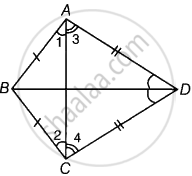
Proof: Since, AB = BC ...(Given)
∴ ∠2 = ∠1 ...(i) [Angles opposite to equal sides are equal]
And AD = CD ...[Given]
⇒ ∠4 = ∠3 ...(ii) [Angles opposite to equal sides are equal]
On adding equations (i) and (ii), we get
∠2 + ∠4 = ∠1 + ∠3
⇒ ∠BCD = ∠BAD ...(iii)
In ΔBAD and ΔBCD,
AB = BC ...[Given]
∠BAD = ∠BCD ...[From equation (iii)]
And AD = CD ...[Given]
∴ ΔBAD ≅ ΔBCD ...[By SAS congruence rule]
Hence, ∠ABD = ∠CBD and ∠ADB = ∠CDB i.e., BD bisects the angles ABC and ADC. ...[By CPCT]
APPEARS IN
RELATED QUESTIONS
Prove that the sum of three altitudes of a triangle is less than the sum of its sides.
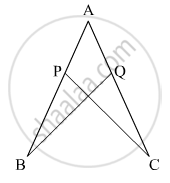
In the given figure, if AB = AC and ∠B = ∠C. Prove that BQ = CP.
If the following pair of the triangle is congruent? state the condition of congruency:
In ΔABC and ΔPQR, BC = QR, ∠A = 90°, ∠C = ∠R = 40° and ∠Q = 50°.
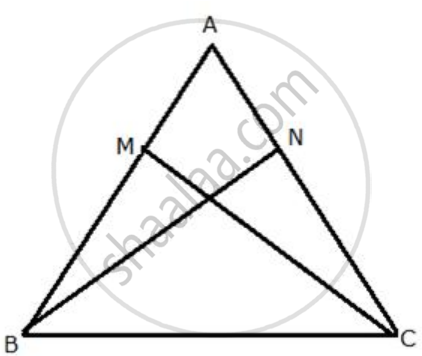
The following figure has shown a triangle ABC in which AB = AC. M is a point on AB and N is a point on AC such that BM = CN.
Prove that: (i) BN = CM (ii) ΔBMC ≅ ΔCNB
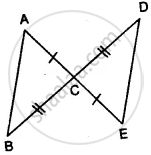
In the given figure, prove that:
(i) ∆ ACB ≅ ∆ ECD
(ii) AB = ED
Which of the following pairs of triangles are congruent? Give reasons
ΔABC;(AB = 5cm,BC = 7cm,CA = 9cm);
ΔKLM;(KL = 7cm,LM = 5cm,KM = 9cm).
If the perpendicular bisector of the sides of a triangle PQR meet at I, then prove that the line joining from P, Q, R to I are equal.
“If two angles and a side of one triangle are equal to two angles and a side of another triangle, then the two triangles must be congruent.” Is the statement true? Why?
The top and bottom faces of a kaleidoscope are congruent.
Without drawing the triangles write all six pairs of equal measures in the following pairs of congruent triangles.
∆ABC ≅ ∆LMN
