Advertisements
Advertisements
Question
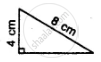
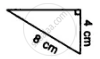
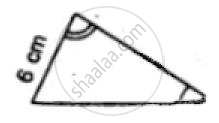
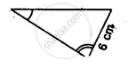
State, whether the pairs of triangles given in the following figures are congruent or not:
Advertisements
Solution
In these right triangles, one side and diagonal of the one, are equal to the corresponding side and diagonal are equal. Hence these are congruent triangles.
(R.H.S. Axiom)
APPEARS IN
RELATED QUESTIONS
In two right triangles one side an acute angle of one are equal to the corresponding side and angle of the othe Prove that the triangles are congruent.
In a ΔABC, if AB = AC and BC is produced to D such that ∠ACD = 100°, then ∠A =
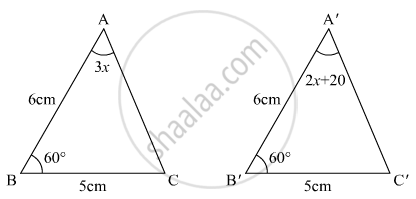
In the given figure, the measure of ∠B'A'C' is
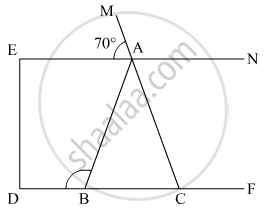
In the given figure, if AE || DC and AB = AC, the value of ∠ABD is
State, whether the pairs of triangles given in the following figures are congruent or not:
In a triangle ABC, if D is midpoint of BC; AD is produced upto E such as DE = AD, then prove that:
a. DABD andDECD are congruent.
b. AB = EC
c. AB is parallel to EC
AD and BE are altitudes of an isosceles triangle ABC with AC = BC. Prove that AE = BD.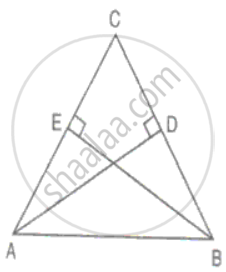
In ΔABC, AB = AC, BM and Cn are perpendiculars on AC and AB respectively. Prove that BM = CN.
Two right-angled triangles ABC and ADC have the same base AC. If BC = DC, prove that AC bisects ∠BCD.
Given that ∆ABC ≅ ∆DEF List all the corresponding congruent angles
