Advertisements
Advertisements
Question
Without drawing the triangles write all six pairs of equal measures in the following pairs of congruent triangles.
∆STU ≅ ∆DEF
Advertisements
Solution
We know that, corresponding parts of congruent triangles are equal.
∠S = ∠D, ∠T = ∠E and ∠U = ∠F
ST = DE, TU = EF and SU = DF
APPEARS IN
RELATED QUESTIONS
Find the measure of each angle of an equilateral triangle.
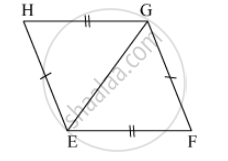
In the pair of triangles in the following figure, parts bearing identical marks are congruent. State the test and the correspondence of vertices by the triangle in pairs is congruent.
In a triangle, ABC, AB = BC, AD is perpendicular to side BC and CE is perpendicular to side AB. Prove that: AD = CE.
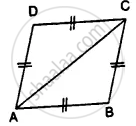
Prove that:
(i) ∆ ABC ≅ ∆ ADC
(ii) ∠B = ∠D
In the given figure P is a midpoint of chord AB of the circle O. prove that OP ^ AB.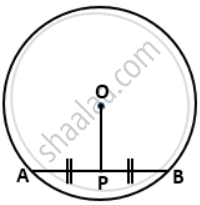
In the figure, BM and DN are both perpendiculars on AC and BM = DN. Prove that AC bisects BD.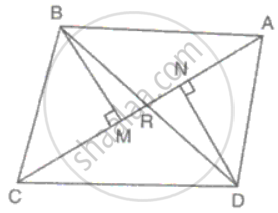
ΔABC is isosceles with AB = AC. BD and CE are two medians of the triangle. Prove that BD = CE.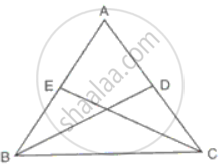
ΔABC is an isosceles triangle with AB = AC. GB and HC ARE perpendiculars drawn on BC.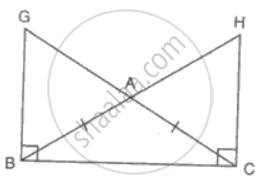
Prove that
(i) BG = CH
(ii) AG = AH
“If two sides and an angle of one triangle are equal to two sides and an angle of another triangle, then the two triangles must be congruent.” Is the statement true? Why?
Two figures are congruent, if they have the same shape.
