Advertisements
Advertisements
Question
State, whether the pairs of triangles given in the following figures are congruent or not:
Δ ABC in which AB = 2 cm, BC = 3.5 cm and ∠C = 80° and Δ DEF in which DE = 2 cm, DF = 3.5 cm and ∠D = 80°.
Advertisements
Solution
In Δ ABC, AB = 2 cm, BC = 3.5 cm and ∠C = 80° and in ∆ DEF, DE = 2 cm, DF = 3.5 cm and ∠D = 80°
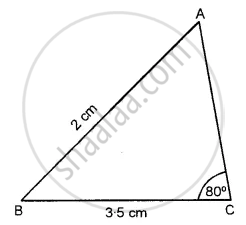
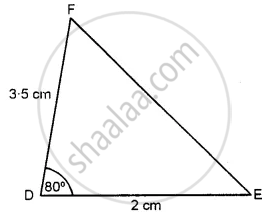
From the figure, we see that two corresponding sides are equal but their included angles are not equal.
Hence, these are not congruent triangles
APPEARS IN
RELATED QUESTIONS
ΔPQR and ΔABC is not congruent to ΔRPQ, then which of the following is not true:
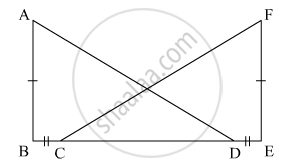
In the given figure, AB ⊥ BE and FE ⊥ BE. If BC = DE and AB = EF, then ΔABD is congruent to
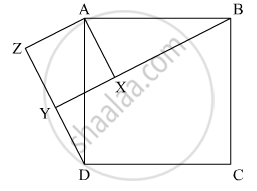
In the given figure, X is a point in the interior of square ABCD. AXYZ is also a square. If DY = 3 cm and AZ = 2 cm, then BY =
In the following example, a pair of triangles is shown. Equal parts of triangle in each pair are marked with the same sign. Observe the figure and state the test by which the triangle in each pair are congruent.
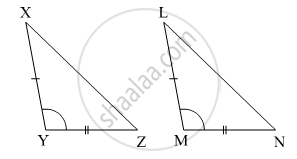
By ______ test
ΔXYZ ≅ ΔLMN
In the following example, a pair of triangles is shown. Equal parts of triangle in each pair are marked with the same sign. Observe the figure and state the test by which the triangle in each pair are congruent.
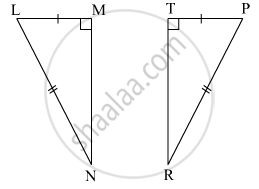
By ______ test
ΔLMN ≅ ΔPTR
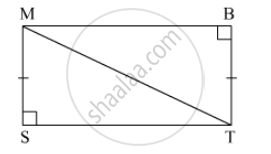
In the pair of triangles in the following figure, parts bearing identical marks are congruent. State the test and the correspondence of vertices by the triangle in pairs is congruent.
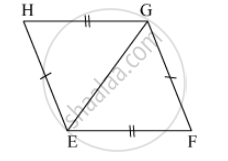
In the pair of triangles given below, the parts shown by identical marks are congruent. State the test and the one-to-one correspondence of vertices by which the triangles in the pair are congruent, the remaining congruent parts.
On the sides AB and AC of triangle ABC, equilateral triangle ABD and ACE are drawn. Prove that:
- ∠CAD = ∠BAE
- CD = BE
State, whether the pairs of triangles given in the following figures are congruent or not:


Prove that in an isosceles triangle the altitude from the vertex will bisect the base.
