Advertisements
Advertisements
Question
In the figure, ∠BCD = ∠ADC and ∠ACB =∠BDA. Prove that AD = BC and ∠A = ∠B.
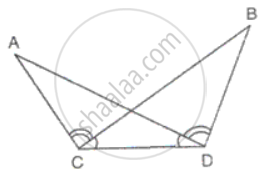
Advertisements
Solution
∠BCD = ∠ADC
∠ACB = ∠BDA
∠BCD + ∠ACB = ∠ADC + ∠BDA
⇒ ∠ACD = ∠BDCACD = BDC
In ΔACD and ΔBCD
∠ACD =∠BDCACD = BDC
∠ADC = ∠BCD
ADC = BCD
CD = CD
Therefore, ΔACD ≅ ΔBCD ...(ASA criteria)
Hence, AD = BC and ∠A = ∠B.
APPEARS IN
RELATED QUESTIONS
If ΔDEF ≅ ΔBCA, write the part(s) of ΔBCA that correspond to ∠E
In a ΔPQR, if PQ = QR and L, M and N are the mid-points of the sides PQ, QR and RP
respectively. Prove that: LN = MN.
If ΔPQR≅ ΔEFD, then ∠E =
In ΔTPQ, ∠T = 65°, ∠P = 95° which of the following is a true statement?
Prove that:
(i) ∆ ABC ≅ ∆ ADC
(ii) ∠B = ∠D

AD and BE are altitudes of an isosceles triangle ABC with AC = BC. Prove that AE = BD.
In the figure, AC = AE, AB = AD and ∠BAD = ∠EAC. Prove that BC = DE.
In the figure, AP and BQ are perpendiculars to the line segment AB and AP = BQ. Prove that O is the mid-point of the line segments AB and PQ.
If ∆PQR is congruent to ∆STU (see figure), then what is the length of TU?

Without drawing the triangles write all six pairs of equal measures in the following pairs of congruent triangles.
∆XYZ ≅ ∆MLN
