Advertisements
Advertisements
Question
In ΔTPQ, ∠T = 65°, ∠P = 95° which of the following is a true statement?
Options
PQ < TP
PQ < TQ
TQ < TP < PQ
PQ < TP < TQ
Advertisements
Solution
PQ < TQ
Explanation:
∠Q = 180° – (95° + 65°)
∠Q = 20°
∴ ∠Q < ∠T < ∠P
∴ PT < PQ < TQ
APPEARS IN
RELATED QUESTIONS
In a ΔPQR, if PQ = QR and L, M and N are the mid-points of the sides PQ, QR and RP
respectively. Prove that: LN = MN.
If ΔPQR≅ ΔEFD, then ∠E =
Which of the following is not a criterion for congruence of triangles?
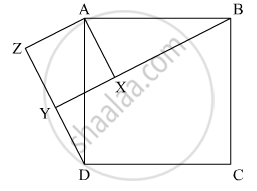
In the given figure, X is a point in the interior of square ABCD. AXYZ is also a square. If DY = 3 cm and AZ = 2 cm, then BY =
In the following example, a pair of triangles is shown. Equal parts of triangle in each pair are marked with the same sign. Observe the figure and state the test by which the triangle in each pair are congruent.
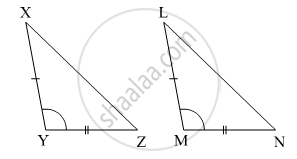
By ______ test
ΔXYZ ≅ ΔLMN
In the following example, a pair of triangles is shown. Equal parts of triangle in each pair are marked with the same sign. Observe the figure and state the test by which the triangle in each pair are congruent.
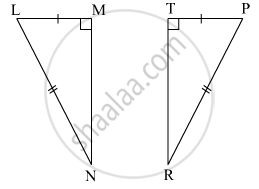
By ______ test
ΔLMN ≅ ΔPTR
From the information shown in the figure, state the test assuring the congruence of ΔABC and ΔPQR. Write the remaining congruent parts of the triangles.
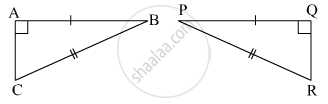
In the pair of triangles in the following figure, parts bearing identical marks are congruent. State the test and the correspondence of vertices by the triangle in pairs is congruent.
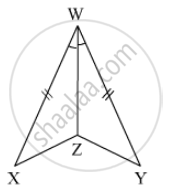
In the pair of triangles given below, the parts shown by identical marks are congruent. State the test and the one-to-one correspondence of vertices by which the triangles in the pair are congruent, the remaining congruent parts.
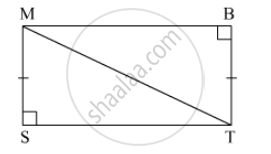
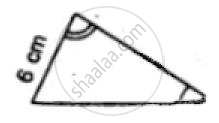
State, whether the pairs of triangles given in the following figures are congruent or not:
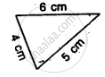
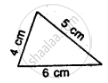
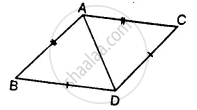
In the given figure, prove that: ∆ ABD ≅ ∆ ACD
State, whether the pairs of triangles given in the following figures are congruent or not:
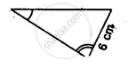
In ΔABC, AB = AC and the bisectors of angles B and C intersect at point O.Prove that BO = CO and the ray AO is the bisector of angle BAC.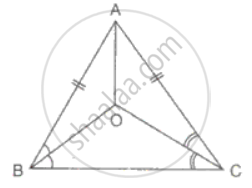
AD and BE are altitudes of an isosceles triangle ABC with AC = BC. Prove that AE = BD.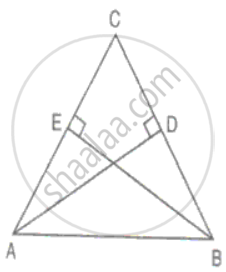
In ΔABC, X and Y are two points on AB and AC such that AX = AY. If AB = AC, prove that CX = BY.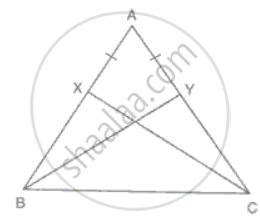
In the given figure ABCD is a parallelogram, AB is Produced to L and E is a midpoint of BC. Show that: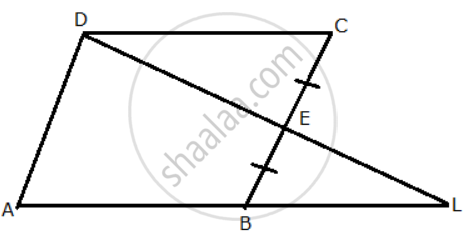
a. DDCE ≅ DLDE
b. AB = BL
c. DC = `"AL"/(2)`
In the figure, AP and BQ are perpendiculars to the line segment AB and AP = BQ. Prove that O is the mid-point of the line segments AB and PQ.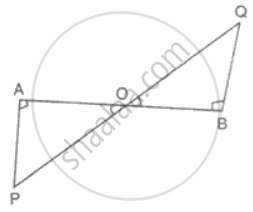
Sides, AB, BC and the median AD of ΔABC are equal to the two sides PQ, QR and the median PM of ΔPQR. Prove that ΔABC ≅ ΔPQR.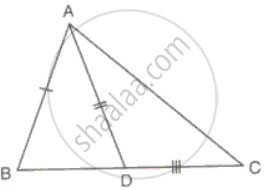
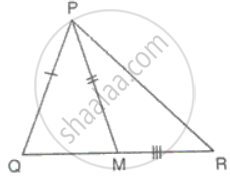
Two right-angled triangles ABC and ADC have the same base AC. If BC = DC, prove that AC bisects ∠BCD.
In triangles ABC and DEF, AB = FD and ∠A = ∠D. The two triangles will be congruent by SAS axiom if ______.
