Advertisements
Advertisements
Question
If AB = QR, BC = PR and CA = PQ, then ______.
Options
∆ABC ≅ ∆PQR
∆CBA ≅ ∆PRQ
∆BAC ≅ ∆RPQ
∆PQR ≅ ∆BCA
Advertisements
Solution
If AB = QR, BC = PR and CA = PQ, then ∆CBA ≅ ∆PRQ.
Explanation:
We know that, if ΔRST is congruent to ΔUVW i.e., ΔRST = ΔUVW, then sides of ΔRST fall on corresponding equal sides of ΔUVW and angles of ΔRST fall on corresponding equal angles of ΔUVW.
Here, given AB = QR, BC = PR and CA = PQ, which shows that AB covers QR, BC covers PR and CA covers PQ i.e., A correspond to Q, B correspond to R and C correspond to P.
or A ↔ Q, B ↔ R, C ↔ P
Under this correspondence,
ΔABC ≅ ΔQRP, so option (a) is incorrect,
or ΔCBA ≅ ΔPRQ, so option (b) is correct,
or ΔBAC ≅ ΔRQP, so option (c) is incorrect,
or ΔBCA ≅ ΔRPQ, so option (d) is incorrect.
APPEARS IN
RELATED QUESTIONS
Which of the following is not a criterion for congruence of triangles?
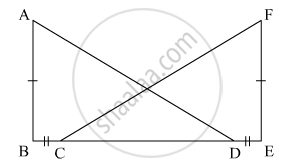
In the given figure, AB ⊥ BE and FE ⊥ BE. If BC = DE and AB = EF, then ΔABD is congruent to
In the following example, a pair of triangles is shown. Equal parts of triangle in each pair are marked with the same sign. Observe the figure and state the test by which the triangles in each pair are congruent.
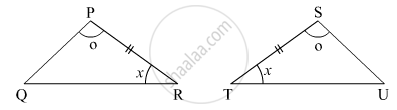
By ______ test
ΔPRQ ≅ ΔSTU
In the following example, a pair of triangles is shown. Equal parts of triangle in each pair are marked with the same sign. Observe the figure and state the test by which the triangle in each pair are congruent.
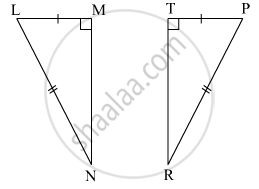
By ______ test
ΔLMN ≅ ΔPTR
Observe the information shown in pair of triangle given below. State the test by which the two triangles are congruent. Write the remaining congruent parts of the triangles.
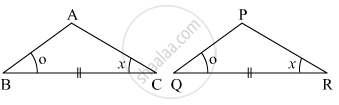
From the information shown in the figure,
In ΔABC and ΔPQR
∠ABC ≅ ∠PQR
seg BC ≅ seg QR
∠ACB ≅ ∠PRQ
∴ ΔABC ≅ ΔPQR ...`square` test
∴ ∠BAC ≅ `square` ...corresponding angles of congruent triangles.
`{:("seg AB" ≅ square),("and" square ≅ "seg PR"):}}` ...corresponding sides of congruent triangles
In the pair of triangles in the following figure, parts bearing identical marks are congruent. State the test and the correspondence of vertices by the triangle in pairs is congruent.
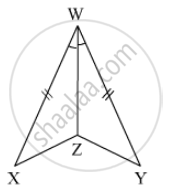
State, whether the pairs of triangles given in the following figures are congruent or not:
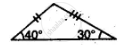
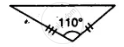
In the given figure, prove that: ∆ ABD ≅ ∆ ACD
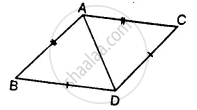
In a triangle ABC, if D is midpoint of BC; AD is produced upto E such as DE = AD, then prove that:
a. DABD andDECD are congruent.
b. AB = EC
c. AB is parallel to EC
“If two sides and an angle of one triangle are equal to two sides and an angle of another triangle, then the two triangles must be congruent.” Is the statement true? Why?
