Advertisements
Advertisements
Question
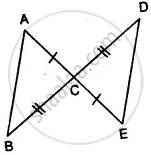
In the given figure, prove that:
(i) ∆ ACB ≅ ∆ ECD
(ii) AB = ED
Advertisements
Solution
(i) In Δ ACB and Δ ECD,
AC = CE ................(given)
∠ACB = ∠DCE ............(vertically opposite angles)
BC = CD .............(given)
∴ Δ ACB ≅ Δ ECD ..............(S.A.S. Axiom)
(ii) Hence AB = ED ................(c.p.c.t.)
Hence proved.
APPEARS IN
RELATED QUESTIONS
BD and CE are bisectors of ∠B and ∠C of an isosceles ΔABC with AB = AC. Prove that BD = CE.
CDE is an equilateral triangle formed on a side CD of a square ABCD. Show that ΔADE ≅ΔBCE.
ABC is an isosceles triangle such that AB = AC and AD is the median to base BC. Then, ∠BAD =
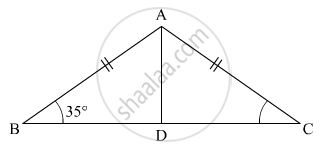
In the pair of triangles given below, the parts shown by identical marks are congruent. State the test and the one-to-one correspondence of vertices by which the triangles in the pair are congruent, the remaining congruent parts.
In the following figure, OA = OC and AB = BC.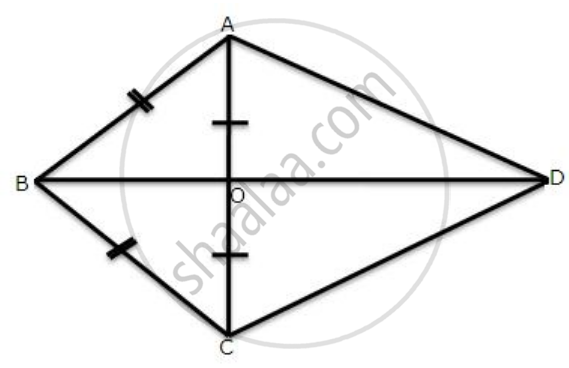
Prove that:
(i) ∠AOB = 90o
(ii) ΔAOD ≅ ΔCOD
(iii) AD = CD
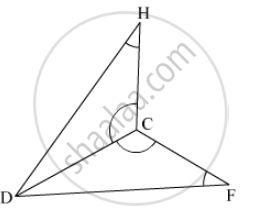
State, whether the pairs of triangles given in the following figures are congruent or not:


In a circle with center O. If OM is perpendicular to PQ, prove that PM = QM.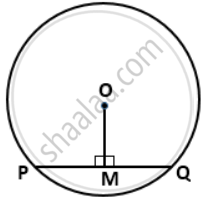
ΔABC is isosceles with AB = AC. BD and CE are two medians of the triangle. Prove that BD = CE.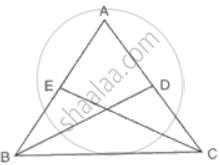
If the given two triangles are congruent, then identify all the corresponding sides and also write the congruent angles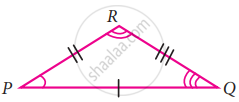
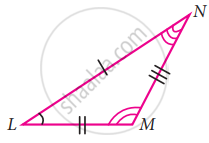
It is given that ∆ABC ≅ ∆RPQ. Is it true to say that BC = QR? Why?
