Advertisements
Advertisements
Question
In an isosceles triangle, if the vertex angle is twice the sum of the base angles, then the measure of vertex angle of the triangle is
Options
100°
120°
110°
130°
Advertisements
Solution
Let ABCbe isosceles triangle
Then
AB = AC
∠B = ∠C
Now it is given that vertex angle is 2 times the sum of base angles
⇒∠A = 2 ∠(B+ C)
⇒∠A = 2 ∠(∠B + ∠B ) (As ∠B = ∠C)
⇒∠A = 2 (2∠B)
⇒∠A = 4 ∠B
Now
∠A + ∠B + ∠C = 180° (Property of triangle)
4∠B + ∠B + ∠B = 180° (Since ∠A = 4∠B, and ∠B = ∠C )
6∠B = 180°
∠B = 30°
∠A = 4∠B
`= 4 xx 30°`
= 120°
APPEARS IN
RELATED QUESTIONS
If ΔDEF ≅ ΔBCA, write the part(s) of ΔBCA that correspond to ∠F
If ΔPQR≅ ΔEFD, then ∠E =
In the adjacent figure, seg AD ≌ seg EC Which additional information is needed to show that ∆ ABD and ∆ EBC will be congruent by A-A-S test?
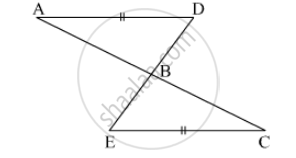
State, whether the pairs of triangles given in the following figures are congruent or not:
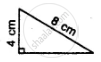
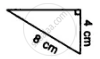
Which of the following pairs of triangles are congruent? Give reasons
ΔABC;(AB = 8cm,BC = 6cm,∠B = 100°);
ΔPQR;(PQ = 8cm,RP = 5cm,∠Q = 100°).
Which of the following pairs of triangles are congruent? Give reasons
ΔABC;(∠B = 90°,BC = 6cm,AB = 8cm);
ΔPQR;(∠Q = 90°,PQ = 6cm,PR = 10cm).
In the given figure P is a midpoint of chord AB of the circle O. prove that OP ^ AB.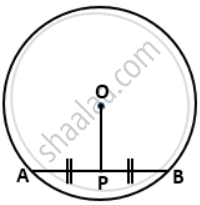
In ΔABC, AB = AC and the bisectors of angles B and C intersect at point O.Prove that BO = CO and the ray AO is the bisector of angle BAC.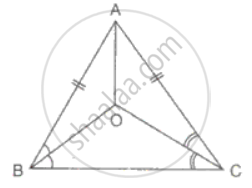
In the given figure, AB = DB and AC = DC. Find the values of x and y.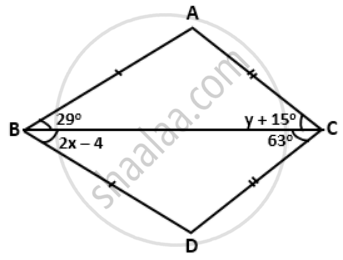
Without drawing the triangles write all six pairs of equal measures in the following pairs of congruent triangles.
∆ABC ≅ ∆LMN
