Advertisements
Advertisements
Question
In ΔPQR ≅ ΔEFD then ED =
Options
PQ
RQ
PR
None of these
Advertisements
Solution
If ΔPQR ≅ ΔEFD
We have to find ED
Since ED = PR, as in congruent triangles equal sides are decided on the basis of “how they are named”.
Hence (c) PR.
APPEARS IN
RELATED QUESTIONS
In a ΔABC, if AB = AC and ∠B = 70°, find ∠A.
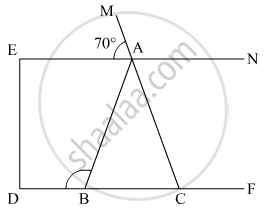
In the given figure, if AE || DC and AB = AC, the value of ∠ABD is
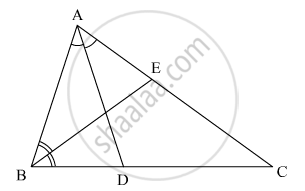
In the given figure, ABC is a triangle in which ∠B = 2∠C. D is a point on side BC such that ADbisects ∠BAC and AB = CD. BE is the bisector of ∠B. The measure of ∠BAC is
In the following diagram, AP and BQ are equal and parallel to each other.
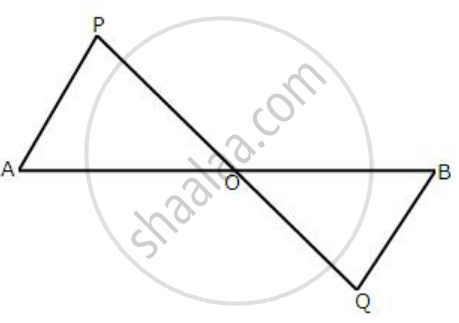
Prove that:
- ΔAOP ≅ ΔBOQ.
- AB and PQ bisect each other.
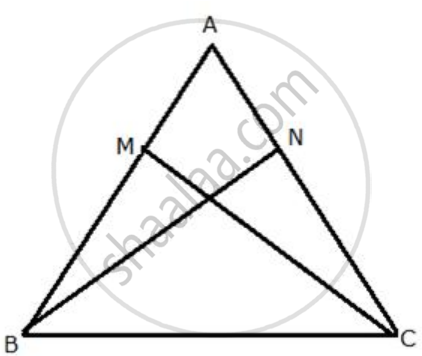
The following figure has shown a triangle ABC in which AB = AC. M is a point on AB and N is a point on AC such that BM = CN.
Prove that: (i) BN = CM (ii) ΔBMC ≅ ΔCNB
In the given figure, prove that: ∆ ABD ≅ ∆ ACD
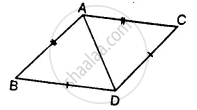
Which of the following pairs of triangles are congruent? Give reasons
ΔABC;(∠B = 70°,BC = 6cm,∠C = 50°);
ΔXYZ;(∠Z = 60°,XY = 6cm,∠X = 70°).
Which of the following pairs of triangles are congruent? Give reasons
ΔABC;(∠B = 90°,BC = 6cm,AB = 8cm);
ΔPQR;(∠Q = 90°,PQ = 6cm,PR = 10cm).
In the figure, ∠BCD = ∠ADC and ∠ACB =∠BDA. Prove that AD = BC and ∠A = ∠B.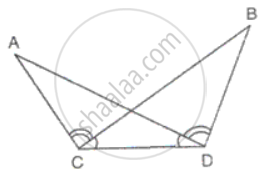
ABCD is a quadrilateral in which AB = BC and AD = CD. Show that BD bisects both the angles ABC and ADC.
