Advertisements
Advertisements
Question
If ΔPQR≅ ΔEFD, then ∠E =
Options
∠P
∠Q
∠R
None of these
Advertisements
Solution
If ΔPQR ≅ ΔEFD
Then we have to find ∠E
From the given congruence ∠E = ∠P, as equal angles or equal sides are decided by the location of the letters in naming the triangles.
Hence (a) ∠P
APPEARS IN
RELATED QUESTIONS
In ΔTPQ, ∠T = 65°, ∠P = 95° which of the following is a true statement?
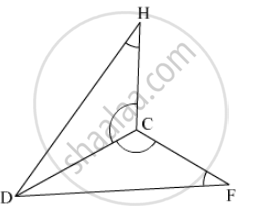
In the pair of triangles given below, the parts shown by identical marks are congruent. State the test and the one-to-one correspondence of vertices by which the triangles in the pair are congruent, the remaining congruent parts.
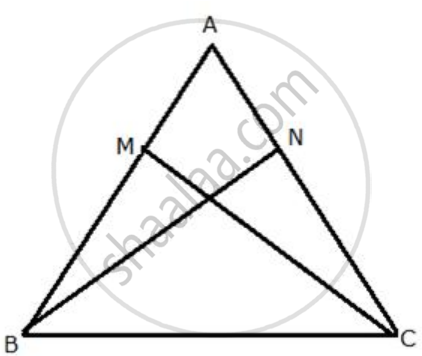
The following figure shown a triangle ABC in which AB = AC. M is a point on AB and N is a point on AC such that BM = CN.
Prove that: ΔAMC≅ ΔANB
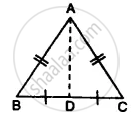
Prove that:
- ∆ ABD ≅ ∆ ACD
- ∠B = ∠C
- ∠ADB = ∠ADC
- ∠ADB = 90°
A is any point in the angle PQR such that the perpendiculars drawn from A on PQ and QR are equal. Prove that ∠AQP = ∠AQR.
In the figure, ∠CPD = ∠BPD and AD is the bisector of ∠BAC. Prove that ΔCAP ≅ ΔBAP and CP = BP.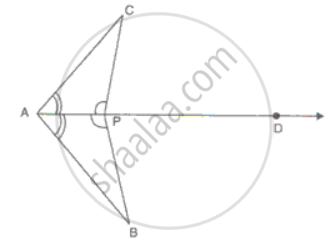
In the figure, RT = TS, ∠1 = 2∠2 and ∠4 = 2∠3. Prove that ΔRBT ≅ ΔSAT.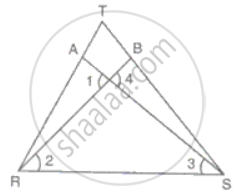
In ΔABC, AD is a median. The perpendiculars from B and C meet the line AD produced at X and Y. Prove that BX = CY.
The top and bottom faces of a kaleidoscope are congruent.
Two figures are congruent, if they have the same shape.
