Advertisements
Advertisements
Question
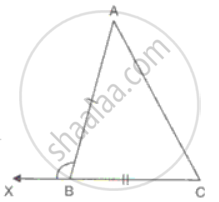
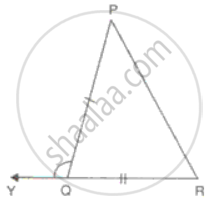
In ΔABC and ΔPQR and, AB = PQ, BC = QR and CB and RQ are extended to X and Y respectively and ∠ABX = ∠PQY. = Prove that ΔABC ≅ ΔPQR.
Advertisements
Solution
In ΔABC and ΔPQR and
AB = PQ
BC = QR
∠ABX + ∠ABC
= ∠PQY + ∠PQR
= 180°
∠ABX = ∠PQY
⇒ ∠ABC = ∠PQR
Therefore,
ΔABC ≅ΔPQR ....(SAS criteria).
APPEARS IN
RELATED QUESTIONS
ΔPQR and ΔABC is not congruent to ΔRPQ, then which of the following is not true:
In the following diagram, AP and BQ are equal and parallel to each other.

Prove that:
- ΔAOP ≅ ΔBOQ.
- AB and PQ bisect each other.
In a triangle, ABC, AB = BC, AD is perpendicular to side BC and CE is perpendicular to side AB. Prove that: AD = CE.
State, whether the pairs of triangles given in the following figures are congruent or not:

In the figure, ∠CPD = ∠BPD and AD is the bisector of ∠BAC. Prove that ΔCAP ≅ ΔBAP and CP = BP.
Prove that in an isosceles triangle the altitude from the vertex will bisect the base.
In ΔABC, AB = AC, BM and Cn are perpendiculars on AC and AB respectively. Prove that BM = CN.
If the given two triangles are congruent, then identify all the corresponding sides and also write the congruent angles

Which of the following rule is not sufficient to verify the congruency of two triangles
Without drawing the triangles write all six pairs of equal measures in the following pairs of congruent triangles.
∆YZX ≅ ∆PQR
