Advertisements
Advertisements
Question
In a triangle ABC, if D is midpoint of BC; AD is produced upto E such as DE = AD, then prove that:
a. DABD andDECD are congruent.
b. AB = EC
c. AB is parallel to EC
Advertisements
Solution
Given:
D os mid-point of BC
⇒ BD = DC
DE = AD
To prove:
a. ΔABD ≅ ΔECD
b. AB = EC
c. AB || EC
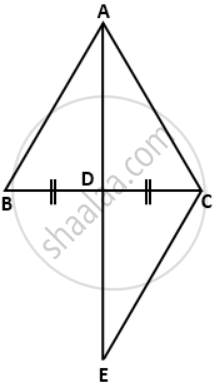
a. In ΔABD and ΔECD
BD = DC ....(given)
∠ADB = ∠CDE ....(vertically opposite angles)
AD = DE ....(given)
∴ By Side-Angle-Side criterion of congruence,
ΔABD ≅ ΔECD
b. The corresponding parts of the congruent triangle are congruent.
∴ AB = EC
c. Also, ∠DAB = ∠DEC ....(c.p.c.t)
∴ AB || EC ....(∠DAB and ∠DEC are alternate angles).
APPEARS IN
RELATED QUESTIONS
If ΔDEF ≅ ΔBCA, write the part(s) of ΔBCA that correspond to `bar(EF)`
In a squared sheet, draw two triangles of equal areas such that
The triangles are congruent.
What can you say about their perimeters?
Observe the information shown in pair of triangle given below. State the test by which the two triangles are congruent. Write the remaining congruent parts of the triangles.

From the information shown in the figure,
In ΔABC and ΔPQR
∠ABC ≅ ∠PQR
seg BC ≅ seg QR
∠ACB ≅ ∠PRQ
∴ ΔABC ≅ ΔPQR ...`square` test
∴ ∠BAC ≅ `square` ...corresponding angles of congruent triangles.
`{:("seg AB" ≅ square),("and" square ≅ "seg PR"):}}` ...corresponding sides of congruent triangles
In ΔTPQ, ∠T = 65°, ∠P = 95° which of the following is a true statement?
If the following pair of the triangle is congruent? state the condition of congruency:
In ΔABC and ΔPQR, BC = QR, ∠A = 90°, ∠C = ∠R = 40° and ∠Q = 50°.
In the given figure ABCD is a parallelogram, AB is Produced to L and E is a midpoint of BC. Show that:
a. DDCE ≅ DLDE
b. AB = BL
c. DC = `"AL"/(2)`
ΔABC is isosceles with AB = AC. BD and CE are two medians of the triangle. Prove that BD = CE.
In ΔABC, AB = AC. D is a point in the interior of the triangle such that ∠DBC = ∠DCB. Prove that AD bisects ∠BAC of ΔABC.
In ΔABC, AD is a median. The perpendiculars from B and C meet the line AD produced at X and Y. Prove that BX = CY.
Two figures are congruent, if they have the same shape.
