Advertisements
Advertisements
Question
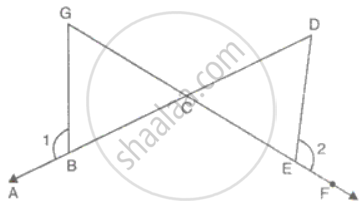
In the figure, BC = CE and ∠1 = ∠2. Prove that ΔGCB ≅ ΔDCE.
Advertisements
Solution
In ΔGCB and ΔDCE and
∠1 + ∠GBC = ∠2 + ∠DEC = 180°
∠1 = ∠2 =
⇒ ∠GBC = ∠DEC
BC = CE
∠GCB = ∠DCE = ...(vertically opposite angles)
Therefore,
ΔGCB ≅ ΔDCE ....(ASA criteria).
APPEARS IN
RELATED QUESTIONS
If ΔDEF ≅ ΔBCA, write the part(s) of ΔBCA that correspond to ∠E
In triangles ABC and PQR, if ∠A = ∠R, ∠B = ∠P and AB = RP, then which one of the following congruence conditions applies:
In a ΔABC, if AB = AC and BC is produced to D such that ∠ACD = 100°, then ∠A =
Observe the information shown in pair of triangle given below. State the test by which the two triangles are congruent. Write the remaining congruent parts of the triangles.

From the information shown in the figure,
in ΔPTQ and ΔSTR
seg PT ≅ seg ST
∠PTQ ≅ ∠STR ...[Vertically opposite angles]
∴ ΔPTQ ≅ ΔSTR ...`square` test
∴ `{:("∠TPQ" ≅ square),("and" square ≅ "∠TRS"):}}` ...corresponding angles of congruent triangles
seg PQ ≅ `square` ...corresponding sides of congruent triangles
If the following pair of the triangle is congruent? state the condition of congruency:
In ΔABC and ΔPQR, BC = QR, ∠A = 90°, ∠C = ∠R = 40° and ∠Q = 50°.
In the given figure P is a midpoint of chord AB of the circle O. prove that OP ^ AB.
AD and BE are altitudes of an isosceles triangle ABC with AC = BC. Prove that AE = BD.
“If two angles and a side of one triangle are equal to two angles and a side of another triangle, then the two triangles must be congruent.” Is the statement true? Why?
Is it possible to construct a triangle with lengths of its sides as 4 cm, 3 cm and 7 cm? Give reason for your answer.
It is given that ∆ABC ≅ ∆RPQ. Is it true to say that BC = QR? Why?
