Advertisements
Advertisements
Question
In a ΔABC, if AB = AC and BC is produced to D such that ∠ACD = 100°, then ∠A =
Options
20°
40°
60°
80°
Advertisements
Solution
In the triangle ABC it is given that
AB = AC
∠ACD = 100°
We have to find ∠A
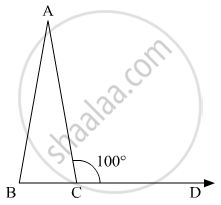
Now ∠ACD + ∠ACB = 180° (linear pair)
SinceAB = AC
So, ∠B = ∠C (by isosceles triangle)
This implies that
∠B =∠C
= 180° - 100
= 80
Now,
∠A + ∠B + ∠C = 180° (Property of triangle)
∠A + 80° + 80° = 180°
∠A = 180° - 160°
∠A = 20°
APPEARS IN
RELATED QUESTIONS
In a squared sheet, draw two triangles of equal areas such that
The triangles are not congruent.
What can you say about their perimeters?
Which of the following is not a criterion for congruence of triangles?
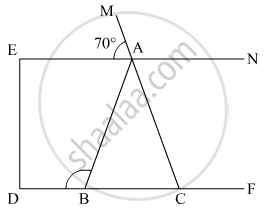
In the given figure, if AE || DC and AB = AC, the value of ∠ABD is
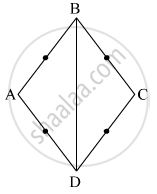
In the given figure, seg AB ≅ seg CB and seg AD ≅ seg CD. Prove that ΔABD ≅ ΔCBD.
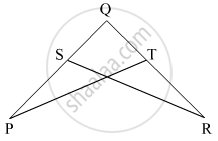
In the given figure, ∠P ≅ ∠R seg, PQ ≅ seg RQ. Prove that, ΔPQT ≅ ΔRQS.
State, whether the pairs of triangles given in the following figures are congruent or not:
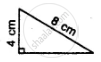
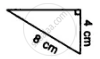
In the given figure ABCD is a parallelogram, AB is Produced to L and E is a midpoint of BC. Show that: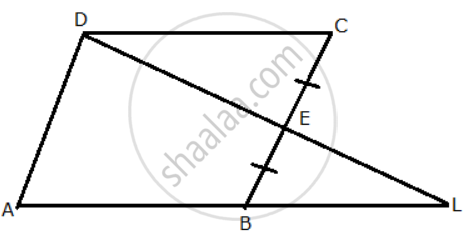
a. DDCE ≅ DLDE
b. AB = BL
c. DC = `"AL"/(2)`
ΔABC is an isosceles triangle with AB = AC. GB and HC ARE perpendiculars drawn on BC.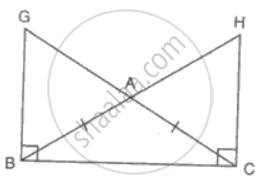
Prove that
(i) BG = CH
(ii) AG = AH
ABCD is a quadrilateral in which AB = BC and AD = CD. Show that BD bisects both the angles ABC and ADC.
Without drawing the triangles write all six pairs of equal measures in the following pairs of congruent triangles.
∆XYZ ≅ ∆MLN
