Advertisements
Advertisements
Question
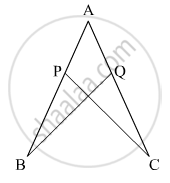
In the given figure, if AB = AC and ∠B = ∠C. Prove that BQ = CP.
Advertisements
Solution
It is given that
AB = AC , and ∠B = ∠C
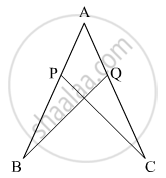
We have to prove that BQ = CP
We basically will prove ΔABQ ≅ ΔACP to show BQ = CP
In ΔABQ and ΔACP
∠B = ∠C (Given)
AB = AC(Given)
And ∠A is common in both the triangles
So all the properties of congruence are satisfied
So ΔABQ ≅ ΔACP
Hence BQ = CP Proved.
APPEARS IN
RELATED QUESTIONS
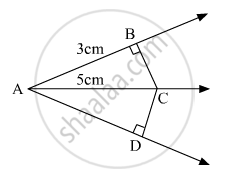
In the given figure, if AC is bisector of ∠BAD such that AB = 3 cm and AC = 5 cm, then CD =
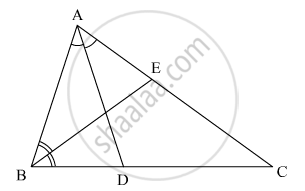
In the given figure, ABC is a triangle in which ∠B = 2∠C. D is a point on side BC such that ADbisects ∠BAC and AB = CD. BE is the bisector of ∠B. The measure of ∠BAC is
In the following diagram, ABCD is a square and APB is an equilateral triangle.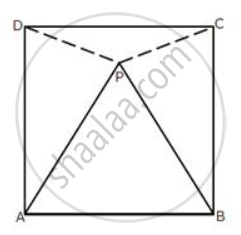
(i) Prove that: ΔAPD≅ ΔBPC
(ii) Find the angles of ΔDPC.
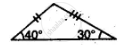
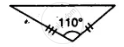
State, whether the pairs of triangles given in the following figures are congruent or not:
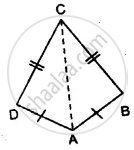
Prove that:
(i) ∆ ABC ≅ ∆ ADC
(ii) ∠B = ∠D
(iii) AC bisects angle DCB
In the given figure P is a midpoint of chord AB of the circle O. prove that OP ^ AB.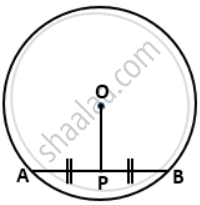
In ΔPQR, LM = MN, QM = MR and ML and MN are perpendiculars on PQ and PR respectively. Prove that PQ = PR.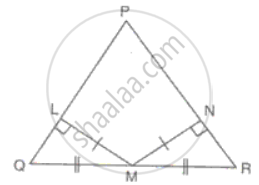
In the given figure ABCD is a parallelogram, AB is Produced to L and E is a midpoint of BC. Show that: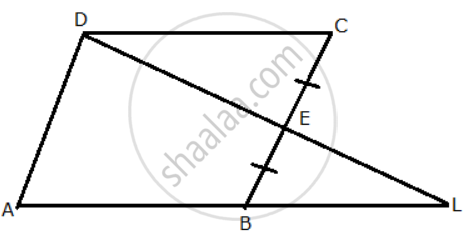
a. DDCE ≅ DLDE
b. AB = BL
c. DC = `"AL"/(2)`
Prove that in an isosceles triangle the altitude from the vertex will bisect the base.
∆ABC and ∆PQR are congruent under the correspondence:
ABC ↔ RQP
Write the parts of ∆ABC that correspond to
(i) `bar"PQ"`
(ii)∠Q
(iii) `bar"RP"`
